

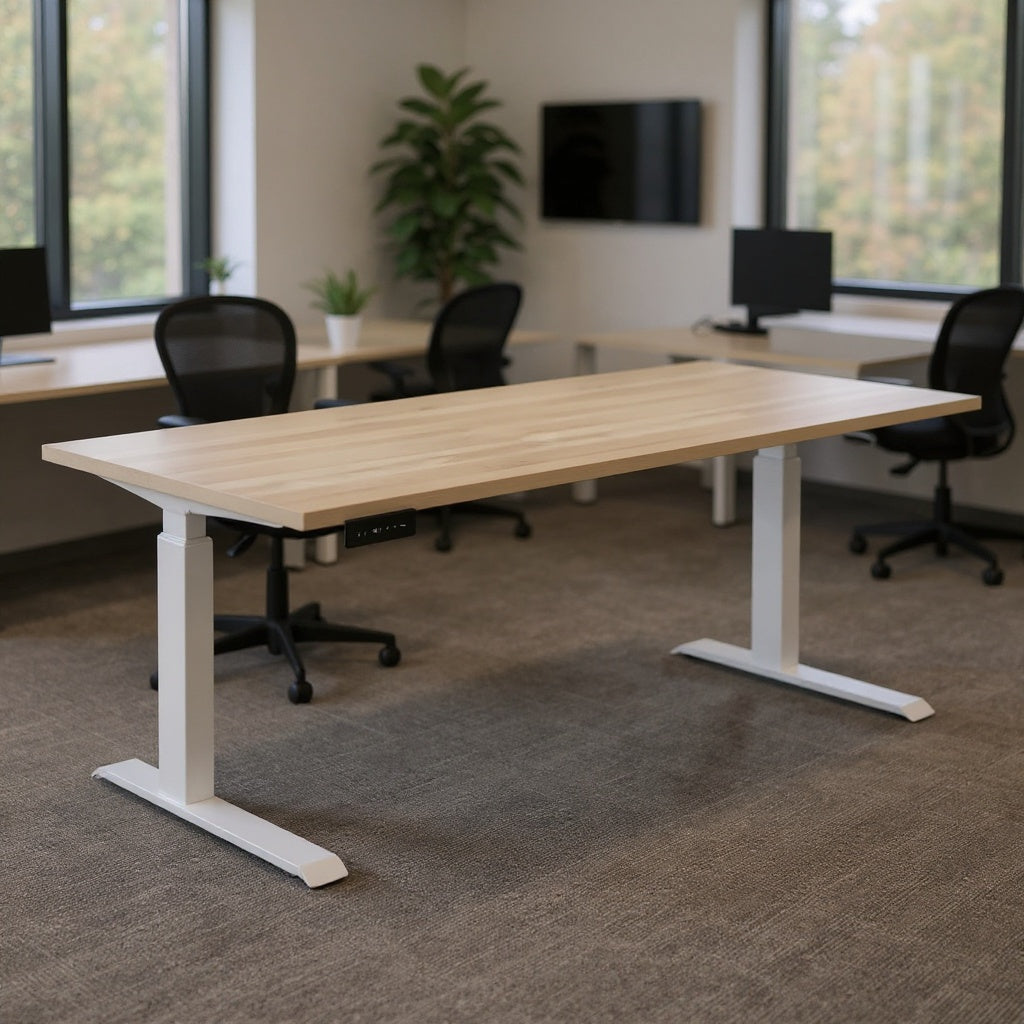
The real question for a business is not whether a standing desk is good for one person at home. It is whether to put sit-stand desks across your team, mix them in, or stay with fixed-height desks, and how to spend the furniture budget to get the most movement for the money. This is the 2026 deployment decision, sit-stand versus fixed for an Ontario office, separate from which specific desk to buy.
Brant Business Interiors, a family-owned division of Office Central Inc., in business since 1964, fits out Ontario offices with both. This guide is about matching the desk type to how your team works, not selling one over the other. For picking a specific model once you have decided, see our commercial standing-desk comparison; for the health and posture side, see our ergonomic seating guidance and, for medical questions, a clinician.
Three ways to deploy desks across a team
A business has three realistic options, and the right answer is usually a mix tuned to roles and budget. The Canadian Centre for Occupational Health and Safety describes a sit-stand desk simply as one that lets a worker alternate between sitting and standing through the day; the deployment question is how widely to provide that.
| Approach | Relative cost per desk | Flexibility | Best for |
|---|---|---|---|
| All sit-stand | Highest | Every desk adjusts for any user | Long-hours desk teams, hot-desking, future-proofing |
| Mixed deployment | Moderate | Sit-stand where it counts, fixed elsewhere | Most offices balancing budget and movement |
| All fixed-height | Lowest | None; one height | Short-use, touchdown, or tightly budgeted desks |
| Fixed desks + converters | Low add-on | Adds standing to existing fixed desks | Retrofitting movement without replacing desks |
What each approach costs per desk
Cost is the real driver of the decision, so plan it per desk and multiply. Fixed-height desks are the cheapest to buy, a fixed-height standing desk is cheaper than a sit-stand one because it has no mechanism, and a powered sit-stand desk carries the premium that buys the adjustability. A desktop converter sits in between: it clamps onto a fixed desk to add standing for a fraction of a full sit-stand replacement.
| Desk type | Typical cost per desk (CAD) | Note |
|---|---|---|
| Fixed-height desk | $300 to $800 | Lowest cost, one height |
| Desktop sit-stand converter | $200 to $500 | Add-on to an existing fixed desk |
| Commercial sit-stand desk | $700 to $1,500 | Powered, full height range |
Add Ontario's 13 percent HST to any of these. Across twenty desks the difference between all-fixed and all-sit-stand is real money, which is why a mixed deployment is where most Ontario offices land.
Who to prioritise, and how to phase it
If the budget will not stretch to sit-stand everywhere at once, put the adjustable desks where movement matters most and phase the rest. Prioritise people at a desk all day, shared and hot-desk positions where one desk serves many body heights, and anyone who has asked for the option. Touchdown desks, short-use and visitor positions, and tightly budgeted areas can stay fixed. A mixed plan delivers most of the benefit of a full rollout at a fraction of the cost, and you can convert fixed desks later with converters or replace them in the next refresh. Health and posture questions belong with a clinician, not a furniture company.
Our top picks (commercial-grade, Ontario-stocked)
- Our #1 pick for a team: the Global FreeFit height-adjustable benching. A height-adjustable benching system from Global with a standard range of 27 to 45 inches, two concealed motors per base, and a whisper-quiet motor option, so a whole row of desks adjusts cleanly for any user. The efficient way to deploy sit-stand across a team.
- For private offices: the Zira height-adjustable suite. A dual-actuator height-adjustable desk suite from Global with a roughly 29.5 to 49-inch range, UL GREENGUARD certified and tested to exceed ANSI/BIFMA, for a manager's office that wants sit-stand in a finished casegood look.
- To retrofit fixed desks: a desktop sit-stand converter. A tool-free unit that clamps onto an existing fixed desk and lifts the worksurface about 14 inches, the budget-friendly way to add standing without replacing desks.
For the full lineup of specific models, sizes, and prices, our commercial standing-desk comparison ranks the picks in detail.
Where to buy office desks in Ontario, and what it costs
Standing desks are sold across every channel. Amazon, Wayfair, Best Buy, and Walmart list consumer sit-stand desks from under $100 to a few hundred dollars, fine for one home office but rarely built for a shared, all-day commercial deployment. Commercial height-adjustable desks from a Canadian manufacturer like Global, bought through a dealer who can plan a whole floor and service the motors, are what an office actually needs. Canadian options include Source Office Furniture, Branch, atWork, and POI. Brant Business Interiors plans the mix of sit-stand and fixed desks, supplies it, and installs it across Ontario.
Frequently Asked Questions
Should an office choose sit-stand or fixed desks?
For most Ontario offices the answer is a mix: sit-stand desks where people sit all day or share a workstation, and fixed-height desks for short-use, touchdown, or tightly budgeted positions. All-sit-stand future-proofs the floor but costs the most; all-fixed is cheapest but offers no adjustability. Plan it per desk against your budget and how each position is used.
Does everyone in the office need a sit-stand desk?
No. Prioritise people at a desk all day, shared and hot-desk positions that serve many body heights, and anyone who has asked for one. Short-use, visitor, and touchdown desks can stay fixed. A mixed deployment delivers most of the benefit for far less than equipping every desk, and you can add more sit-stand desks or converters later.
Are sit-stand desks worth it for a business?
They are worth it where people sit for long stretches, because the ability to alternate posture supports comfort and keeps a shared desk usable by different body heights, which is why many employers now offer them. They are less essential for short-use or touchdown positions. The business case is strongest as a targeted, mixed deployment rather than equipping every desk by default.
What is the difference between a fixed-height standing desk and a sit-stand desk?
A fixed-height standing desk is set at one standing height and cannot be lowered, so it suits a dedicated standing position; a sit-stand desk adjusts between sitting and standing heights for the same user. The sit-stand desk costs more because of its lifting mechanism, while a fixed-height standing desk is cheaper but far less flexible.
Can you add standing to existing fixed desks?
Yes. A desktop sit-stand converter clamps onto an existing fixed desk and raises the worksurface so the user can stand, for a fraction of the cost of replacing the desk. It is the practical way to add movement to a floor of fixed desks without a full refit, and a sensible first phase before a larger sit-stand rollout.
The bottom line
Sit-stand versus fixed is a deployment and budget decision, not a one-person health debate: put adjustable desks where people sit longest and share workstations, keep fixed desks for short-use positions, and use converters to retrofit the rest. Our top pick for a team rollout is the Global FreeFit benching, with converters where you are phasing it in. Tell us your headcount and how the desks are used and we will plan the mix, supply it, and install it across Ontario. Request a Quote or call 1-800-835-9565 to start with a free design layout.
This article is provided for general informational purposes only and does not constitute legal, financial, procurement, or other professional advice. Pricing and specifications reflect publicly available manufacturer information and Canadian market data and are subject to change without notice. Brant Business Interiors makes no representations or warranties, express or implied, as to the accuracy, completeness, or currency of this content. For details specific to your project, please contact us for a quote or consultation.Published June 4, 2026.