

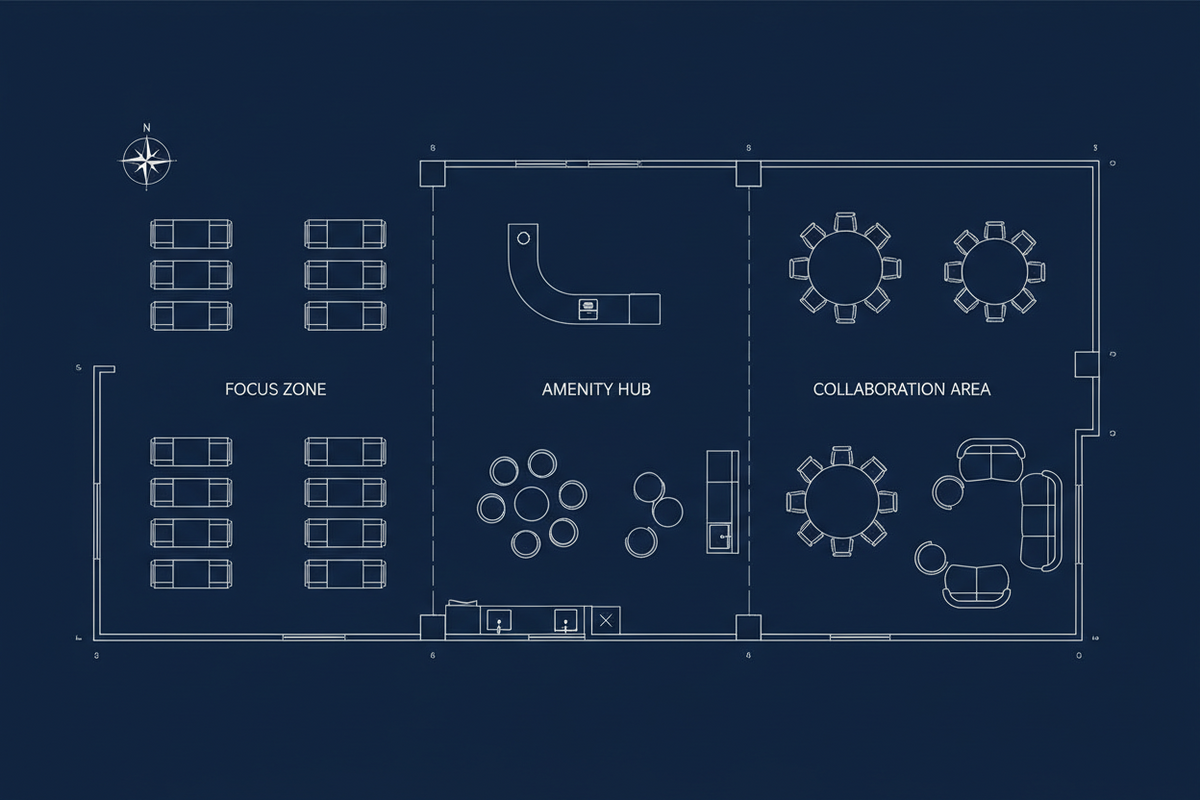
Office space planning is the work of deciding how much space your team needs, then dividing a floor plate into the right mix of workstations, meeting rooms, focus spaces, and shared areas before a single desk is ordered. Most Canadian offices budget somewhere between 150 and 200 square feet of usable area per employee once circulation and shared rooms are counted, but that single number hides the real decisions: how dense to go, how many people share each desk, and how much of the floor goes to collaboration rather than rows of workstations. This guide walks Ontario businesses through the quantitative side of planning a workspace, with Canadian benchmarks, density trade-offs, and a phase-by-phase process. It is written by Brant Business Interiors, a commercial furniture dealer that plans and installs offices across Ontario.
One distinction up front. Space planning is not the same as choosing a layout style or picking finishes. The layout question, open plan versus private offices versus a hybrid floor, has its own home in our guide on how to plan an office layout in Ontario. Space planning sits one level up from that: it is the arithmetic of square footage, headcount, and zones that tells you whether a given layout even fits the floor you are leasing. And the closely related question of exactly how many square feet each person needs is answered in detail in our companion guide on how much office space you need per employee. This page owns the planning method that ties those together.
What office space planning actually decides
A good space plan answers four questions in order, and each one constrains the next:
- How much total space. Headcount multiplied by a density target, plus the shared rooms and circulation that every office needs whether it has ten people or two hundred.
- How to divide it. The split between individual workstations, enclosed offices, meeting and focus rooms, and amenity space such as kitchens and reception.
- How to zone it. Grouping those spaces into neighbourhoods so that quiet work, collaborative work, and client-facing work do not bleed into each other.
- How to furnish it. The desks, panels, storage, and seating that turn a floor plan into a working office, sized so they actually fit the plan rather than forcing it.
Skip the arithmetic and you get the two failure modes every facilities manager knows: a floor that feels empty and over-leased, or one so dense that there is nowhere to take a call. Planning is how you land between them on purpose.
How much space: the Ontario benchmark
The headline figure is space per person, but the more useful planning number is how a floor divides by function. Published Canadian and industry guidance converges on a usable range of roughly 150 to 200 square feet per employee for a conventional office once you include the rooms and corridors everyone shares, with denser activity-based floors pushing lower. The table below breaks a typical floor into its functional parts so you can budget each one rather than guessing at a single multiplier. Treat these as common planning patterns, not fixed rules; your mix shifts with how client-facing, collaborative, or focus-heavy the work is.
| Function | Typical share of usable area | Typical footprint | What it covers |
|---|---|---|---|
| Individual workstations | 40 to 60 percent | About 36 to 64 sq ft per open workstation | Open benches and cubicles where focused desk work happens |
| Enclosed offices | 5 to 20 percent | About 90 to 150 sq ft each | Private offices for roles that need confidentiality or quiet |
| Meeting and focus rooms | 10 to 20 percent | Huddle 60 to 100 sq ft; boardroom 150 to 300 sq ft | Boardrooms, huddle rooms, phone booths, project rooms |
| Amenity and support | 10 to 20 percent | Varies with kitchen and reception scope | Reception, kitchen and breakroom, copy and storage, server |
| Circulation | 25 to 40 percent of gross | Built into the gross-to-usable ratio | Corridors, aisles, and the code-required paths between everything |
Two cautions on the numbers. First, circulation is the figure people forget: a floor can lose a third of its gross area to corridors and required clearances before any furniture goes in, which is why the per-person ranges that include circulation run higher than a bare workstation footprint. The Canadian Centre for Occupational Health and Safety suggests a staff workstation of about 72 square feet, roughly 8 by 9 feet, as a comfortable open or enclosed working area; that is the desk, not the share of meeting rooms and corridors that also belongs to each person. Second, the per-person sizing question deserves its own math, which is why we keep the full role-by-role table in the dedicated sizing guide and use this page for the functional split.
Density: the trade-off that drives everything
Density is the single lever that moves your lease cost the most, and it is a genuine trade-off rather than a number to maximise. A denser floor costs less per head and shortens the walk between teammates; a more generous floor is quieter, easier to reconfigure, and more forgiving of growth. The table sets the common density bands against what each one buys and costs.
| Density band | Usable sq ft per person | Feels like | Best for | The cost |
|---|---|---|---|---|
| Generous | 200 to 250 | Spacious, lots of enclosed offices | Law, finance, executive, client-facing firms | Highest rent per head |
| Standard | 150 to 200 | Balanced open plan with shared rooms | Most professional and corporate offices | Moderate; the common Canadian default |
| Efficient | 100 to 150 | Open benching, fewer private offices | Tech, agencies, growing teams | Tighter circulation, more noise to manage |
| Activity-based | 60 to 125 | Shared desks, varied settings, hotelling | Hybrid teams where not everyone is in daily | Needs booking discipline and acoustic zones |
The activity-based band only works when fewer people are in than the headcount suggests, which is the reality of most hybrid Ontario offices in 2026. If your team is in two or three days a week on staggered schedules, planning a desk for every name on the payroll wastes space you are paying for. That is the territory of desk-sharing ratios and neighbourhood design, which we cover in depth in our guide to designing for hybrid and activity-based work.
Zoning the floor into neighbourhoods
Once you know how much space and how dense, the plan becomes a map of neighbourhoods: clusters of related settings placed so that incompatible activities are not next to each other. The principle is simple. Loud and quiet should not share a wall, client-facing and heads-down should not share a sightline, and the spaces people use all day should get the best daylight. The table sets out the common neighbourhood types and what each one needs from its furniture.
| Neighbourhood | Primary activity | Acoustic need | Typical furniture |
|---|---|---|---|
| Focus zone | Heads-down individual work | Quiet; screened or enclosed | Benches with dividers, task seating, personal storage |
| Collaboration zone | Team and project work | Tolerant of noise; contained | Larger benches, project tables, writable surfaces |
| Meeting cluster | Scheduled and ad-hoc meetings | Enclosed; managed acoustics | Boardroom and huddle tables, conference seating |
| Client-facing front | Reception and visitor meetings | Presentable and calm | Reception desk, guest seating, display storage |
| Amenity hub | Breaks, informal touchpoints | Buffer between loud and quiet | Cafe seating, lounge, soft furniture |
The furniture is where neighbourhoods become real, and it is where planning most often goes wrong because pieces are chosen before the plan is set. A focus zone built on a four-person benching cluster, with a footprint around 96 by 50 inches for the group, plans far more predictably than four desks bought separately, and it carries power and data to every seat. Where two teams sit back to back, a six-person bench with bridges, built on an anodized aluminum frame with felt acoustic dividers, both seats the group and screens it. Add PET-felt privacy desk-top dividers, 30 inches wide and made from polyester with 50 percent post-recycled content, to lift the screening at individual seats without building walls. The point of planning by furniture module is that the module has a known size, so the plan adds up.
The planning process, phase by phase
Space planning is a sequence, and doing the phases out of order is how projects blow their budget. The table sets the typical phases, who leads each, and what each one should produce before the next begins.
| Phase | What happens | Who leads | Output before moving on |
|---|---|---|---|
| 1. Programming | Count people, roles, growth, and the rooms the business needs | Facilities or operations lead | A space program: headcount, room list, density target |
| 2. Test-fit | Lay the program onto the actual floor plate to confirm it fits | Designer or dealer space planner | A test-fit drawing showing the plan fits the floor |
| 3. Block and zone | Place neighbourhoods, circulation, and daylight access | Designer with the business | A blocking plan with neighbourhoods located |
| 4. Furniture plan | Specify desks, storage, and seating to the zones | Furniture dealer | A furniture plan and quote that matches the blocking |
| 5. Delivery and install | Schedule, deliver, and professionally install | Dealer install team | An installed, working floor |
The test-fit is the phase worth slowing down for. A test-fit is a quick drawing that places your space program onto the real floor plate, and it answers the only question that matters before you sign a lease or commit to a layout: does it fit, with room to work and room to grow? A test-fit can show that a floor you thought was too small actually holds your team at standard density, or that a floor you were about to lease forces you into benching you did not want. It is the cheapest insurance in the whole process, and it is exactly the kind of drawing a furniture dealer with in-house planning can turn around quickly.
Furniture is the unit of planning
A space plan is only as reliable as the dimensions it is built from, which is why planning from real products beats planning from generic blocks. Every piece below carries verified dimensions and third-party testing, so a plan built on them holds up when the furniture arrives. For focus and team zones, the planning building blocks are benching modules and task seating: a Kody mesh task chair, rated to 300 pounds with a synchro-tilt mechanism and GREENGUARD Gold certification, is a sensible standard-issue seat that plans across a whole floor at one price point. For storage, a two-drawer lateral file at 36 by 24 by 29.6 inches with BIFMA LEVEL and GREENGUARD Gold certification gives each neighbourhood a known storage footprint rather than a guess. The discipline is the same throughout: pick the module, know its size, and the plan adds up. Browse our height-adjustable desks and benching and our range of commercial task and ergonomic seating to see the modules a plan is built from.
This is also where the breadth of a multi-line dealer earns its place in planning. Because Brant Business Interiors carries several Canadian manufacturers rather than one line, a single plan can mix benching from one maker, seating from another, and storage from a third to hit one budget and one delivery, instead of forcing every zone into a single catalogue. Global Furniture Group, the manufacturer behind much of the benching and storage above, is a Canadian-founded maker, and pairing its systems with seating chosen for each zone is the kind of cross-line planning a single-brand supplier cannot do.
Ontario-specific planning considerations
Planning an office in Ontario carries a few realities worth building in from phase one. Building and fire codes set minimum corridor widths and exit paths that eat into usable area, which is why the circulation figure is not optional. Occupational health guidance, including the Canadian Centre for Occupational Health and Safety workstation figure cited above, informs comfortable workstation sizing. And for public-sector and broader public sector buyers, the procurement path matters as much as the plan: Brant Business Interiors is registered under our parent legal entity, Brant Basics, as an authorized OECM Supplier Partner under Agreement 2025-470, so eligible Ontario organisations can plan, furnish, and purchase through us without running a separate competitive process. Delivery and installation are Ontario-wide, with professional on-site installation of workstations and panel systems rather than flat-packed boxes left at the door, which means the plan you approve is the plan that gets built.
Where Brant Business Interiors fits
We are the furniture dealer in the planning process, and the value we add is turning a space program into a furniture plan that fits the floor and the budget. That starts with a free design consultation: we test-fit your floor plate, zone it into neighbourhoods, and specify real products with known dimensions to the plan, then deliver and install across Ontario with one point of contact for service afterward. A designer or architect may lead the base building work on a large fit-out, and that is the right call for a major renovation; where the project is furnishing and planning a working office, a multi-line dealer that plans, supplies, installs, and services is built for exactly that. If you are sizing a move, a renovation, or a growing team, that is the conversation to start.
Frequently Asked Questions
How much office space do I need per employee in Canada?
Most Canadian offices plan for roughly 150 to 200 square feet of usable space per employee once shared rooms and circulation are counted, with efficient open-plan floors going lower and generous or private-office-heavy floors going higher. The bare workstation itself is smaller; the Canadian Centre for Occupational Health and Safety suggests about 72 square feet for a comfortable staff workstation. For the full role-by-role sizing math, see our dedicated guide on how much office space you need.
What is office space planning?
Office space planning is the process of deciding how much total space a team needs, then dividing a floor into the right proportions of workstations, offices, meeting rooms, and shared areas, and zoning those into neighbourhoods before any furniture is ordered. It comes before choosing a layout style and before specifying furniture, because it determines whether a given layout fits the floor at all.
How do I calculate how much space my office needs?
Multiply your headcount by a density target in usable square feet per person, then add the meeting rooms, amenity space, and circulation the office needs regardless of headcount. A team of 20 planned at a standard 150 square feet per person needs roughly 3,000 square feet of usable area as a starting point, which a test-fit then confirms against a specific floor plate.
What is a test-fit and why does it matter?
A test-fit is a quick drawing that places your space program onto a real floor plate to confirm it fits with room to work and grow. It is the cheapest insurance in the planning process because it can reveal, before you sign a lease, that a floor is too tight or that a smaller floor would do, saving you from leasing the wrong space.
What are office neighbourhoods?
Neighbourhoods are clusters of related settings, such as a focus zone, a collaboration zone, and a meeting cluster, placed so that incompatible activities do not sit next to each other. Zoning by neighbourhood keeps quiet work away from loud work and client-facing space away from heads-down space, and it makes the floor easier to use and to reconfigure later.
How does space planning differ from interior design?
Space planning is the quantitative work of square footage, headcount, density, and zoning that decides how a floor is divided. Interior design covers finishes, materials, lighting, and the look of the space. Planning comes first and sets the constraints; design makes the planned space work and look the way the business wants.
The bottom line
Office space planning is arithmetic before it is design: headcount times density, plus the rooms and circulation everyone shares, divided into neighbourhoods, and built from furniture with known dimensions. Get the numbers right and the layout, the lease, and the budget all fall into place; skip them and you pay for empty space or fight a floor that is too tight. Brant Business Interiors plans, supplies, and installs commercial offices across Ontario, and we can test-fit your floor and turn it into a furniture plan that fits. Request a Quote or call 1-800-835-9565 to start with a free design layout.
This article is provided for general informational purposes only and does not constitute legal, financial, procurement, or other professional advice. Pricing and specifications reflect publicly available manufacturer information and Canadian market data and are subject to change without notice. Brant Business Interiors makes no representations or warranties, express or implied, as to the accuracy, completeness, or currency of this content. For details specific to your project, please contact us for a quote or consultation.Published June 11, 2026.