

Waterloo Region runs on a different clock than most of Ontario. A startup that signed a small lease this year can double its headcount before the year is out, and the office that felt right in January is short a dozen desks by summer. Furnishing a tech company in Kitchener, Waterloo, Cambridge, or Guelph is not really about picking nice desks; it is about building a workspace that can grow, flex, and help you hire, without a costly reset every time the team expands. This guide is for founders, office managers, and operations leads in the corridor who need furniture that keeps up with the pace, not furniture that has to be replaced the moment it does.
Brant Business Interiors, a family-owned division of Office Central Inc. furnishing Ontario workplaces since 1964, supplies and installs office furniture across the Waterloo Region, with the same crew planning the floor and putting it in. The region is one of Canada's densest technology clusters, home to a deep bench of fast-growing software, hardware, and engineering firms alongside the university talent that feeds them. Furnishing into that environment has its own demands, and the rest of this guide walks through them, with a practical eye on how a scaling team should actually spec a space.
Why a tech fit-out is its own problem
The furniture needs of a law firm or an accounting practice are relatively stable: the headcount moves slowly, the layout is settled, and the look is conservative by design. A scaling tech company is the opposite on every axis. Growth is fast and lumpy, hybrid schedules mean the desk count rarely matches the headcount, and the space doubles as a recruiting tool in a market where talent has options. A fit-out that ignores those realities ages badly, while one that plans for them quietly saves money every time the team grows.
That is why the right starting question for a tech office is not which desk looks best, but how this space changes when we add ten people, or shift to three days in-office, or open a second team room. Furniture chosen against that question behaves very differently from furniture chosen for a photo on move-in day.
What a scaling team actually needs from its furniture
Rather than a style checklist, here is how the real pressures on a growing tech company map to the way you should specify furniture. Read it as a planning lens: each need is a decision you can get right early or pay for later.
| Team pressure | Why it matters as you grow | How to spec for it |
|---|---|---|
| Fast, lumpy headcount growth | Desk demand jumps in steps, often mid-lease | Modular benching you can add to in matching runs, not one-off desks |
| Hybrid and desk-sharing | Fewer desks than people; usage shifts by day | Shared benching and touchdown stations sized to peak days, not headcount |
| Focus versus collaboration | Open floors get loud; deep work suffers | Acoustic pods and quiet rooms balanced against open benching |
| Recruiting and brand | The office is part of the pitch to candidates | A few design-forward spaces that photograph and tour well |
| Budget discipline | Runway is finite; furniture is not the mission | Canadian-made contract-grade value that lasts, bought to scale |
| Wellbeing and retention | Long days at a screen take a toll | Sit-stand desks and ergonomic seating as standard, not perks |
Build the floor to grow, not to fill
Modular benching beats one-off desks
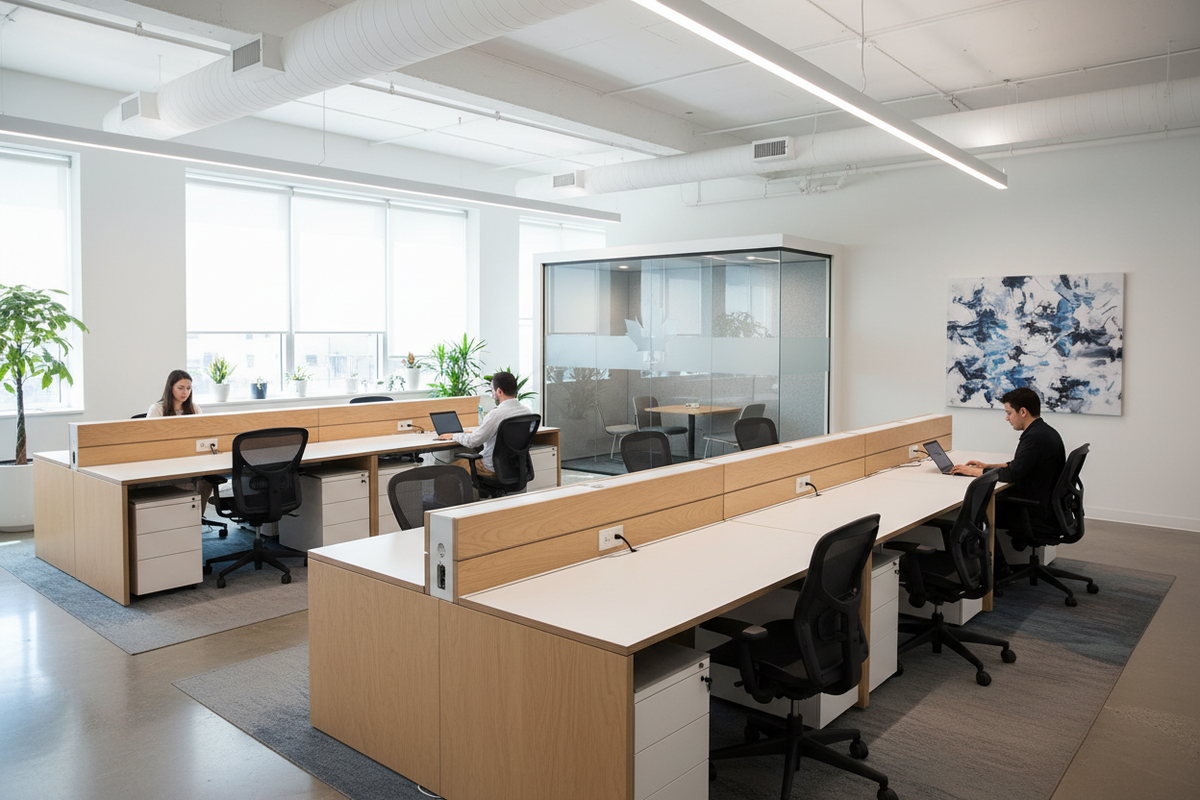
The single most useful decision a scaling team can make is to standardize on a modular benching system rather than buying individual desks as people arrive. Benching is designed to be extended: you add stations to an existing run in the same finish, share power and cable management down the spine, and keep a consistent look as the floor grows from eight seats to thirty. Buy a dozen mismatched desks instead and every expansion is a fresh hunt for something that almost matches, with a floor that looks assembled by accident. The system approach is what lets a fast-growing office stay coherent through three rounds of hiring.
Plan for hybrid, not for everyone at once
Most corridor tech teams now run hybrid, which changes the math: you rarely need a dedicated desk for every name on the payroll. Sizing the floor to realistic peak days, with shared benching and a few touchdown stations, frees both budget and square footage for the things that actually help, more meeting rooms, better quiet space, a proper kitchen. The trap is furnishing for a full-attendance day that never happens; the fix is planning the desk count around how the team really shows up.
Protect deep work with quiet space
Open benching is efficient and collaborative, and it is also loud, which is death to the focused work that engineering and product teams live on. The answer is not to wall everyone off; it is to balance the open floor with acoustic pods, phone booths, and small quiet rooms so people can drop into focus or take a call without booking a boardroom. Planned in from the start, that balance is cheap insurance against the productivity drain of a floor that is all open and no refuge.
Wire the floor for density before anyone sits down
Tech teams are power-hungry in a way that catches a lot of fit-outs out. A developer runs two or three monitors, a docking station, a laptop, and a phone charger, and a bench of eight of them is a serious electrical and cabling load. Furniture chosen without that in mind turns into a tangle of extension cords across the floor within a week. The fix is to treat power and data as a furniture decision, not just an electrical one: benching with a powered spine, generous cable trays and grommets, and a plan for how many outlets and data drops each station really needs. Monitor arms belong in the same conversation, because they clear the desk, let people set an ergonomic screen height, and keep a dense bench from feeling cramped. Get this right and a row of workstations stays clean and flexible as you add seats; get it wrong and every new hire means another cable run improvised under a desk. For a fast-growing team, the difference between a floor that scales gracefully and one that descends into cord chaos is usually decided here, in the unglamorous detail of how the furniture handles power.
A concrete example for a growing team
To make this tangible, consider a workstation we supply from the Canadian manufacturer Global Furniture Group. The Global four-person benching workstation is a shared cluster with a thermally fused laminate top, individual privacy panels, a full-height modesty panel, and integrated wire management, made in Canada and sold by the station so a run can be extended as the team grows. It is a clean illustration of the build-to-grow idea: start with one cluster for a new pod, add matching stations as you hire, and keep the floor consistent without re-buying. Pair it with height-adjustable sit-stand desks where wellbeing and long screen hours matter, and the working floor is both scalable and humane. Our space planning for growth maps that floor to your building and your hiring plan before anything is ordered. For the spaces that do double duty as a recruiting tool, our professional services fit-outs show how a more polished, client-ready look comes together.
Furnishing across the corridor: Kitchener, Waterloo, Cambridge, and Guelph
The corridor is not one market but a cluster of connected ones, and we furnish across all of it. For the twin core of the region, our guide to office furniture in Kitchener and Waterloo covers the local detail for teams in the tech and university heart of the area. Cambridge has its own fast-growing base of manufacturing and technology employers, and our page on office furniture in Cambridge speaks to that mix. Guelph, with its university and a growing roster of science and technology firms, rounds out the corridor; we furnish and install there on the same model even where a dedicated city page is still to come. Wherever the office sits, the approach is consistent: plan the floor for growth, supply contract-grade Canadian-made furniture, and install it with our own crew so a scaling team is not also managing a furniture project.
Why local and Canadian-made matters more here, not less
It can be tempting for a cost-conscious startup to order desks online and assemble them in a weekend. For a handful of seats that can work; for a floor that will grow, it rarely does. A local dealer relationship means the next ten desks match the first ten, parts and additions are sourced close by, and one team plans, delivers, and installs so founders and office managers can stay focused on the business. Canadian-made contract furniture adds durability that survives daily multi-user use and a domestic supply chain that does not strand you waiting on an import when you need to expand fast. In a region where growth is the default, the furniture that keeps up is local, contract-grade, and planned, not flat-packed and hoped for.
There is also a procurement angle for the corridor's public and broader-public-sector employers, including its universities, colleges, and research institutions. Brant Business Interiors is registered under our parent legal entity, Brant Basics, as an authorized OECM Supplier Partner, so eligible Ontario broader-public-sector organizations can purchase office furniture through that provincial agreement, in many cases without issuing a separate public tender, which simplifies buying for the institutional side of the region's technology ecosystem.
Frequently Asked Questions
What is the best office furniture for a tech company in Waterloo Region?
The best fit for a corridor tech company is furniture built to scale: a modular benching system you can extend in matching runs as you hire, shared and touchdown stations sized for hybrid attendance, acoustic pods to protect focus, and sit-stand desks and ergonomic seating as standard. Style matters for the spaces that recruit, but the core decision is choosing contract-grade, expandable systems over one-off desks that cannot keep up with growth.
Do you serve Kitchener, Cambridge, and Guelph?
Yes. We supply and install office furniture across the Waterloo Region corridor, including Kitchener and Waterloo, Cambridge, and Guelph, with our own crew planning and installing the floor. The model is the same in each: plan for growth, supply Canadian-made contract furniture, and install it locally, so a scaling team gets a finished, consistent office rather than a pile of boxes to assemble.
How do you furnish a startup office on a budget?
Spend where it scales and save where it does not. Standardize on an expandable benching system so every round of hiring extends the floor instead of replacing it, size the desk count to realistic hybrid attendance rather than full headcount, and put the design budget into the few spaces that tour and photograph well for recruiting. Canadian-made contract furniture costs more than flat-pack up front and far less over a floor's life, because it survives the use and matches when you grow.
Is benching or private offices better for a tech team?
For most scaling tech teams, open benching is the better backbone because it is collaborative, space-efficient, and easy to extend, while a small number of private offices and quiet rooms handle the focus and confidential work. The mistake is going all the way to either extreme. A balanced floor, mostly benching with enough acoustic pods and closed rooms to protect deep work, fits how product and engineering teams actually operate.
Can the furniture scale as we grow?
Yes, if you choose for it from the start. A modular benching system lets you add stations in the same finish to an existing run, so the floor grows from a single pod to a full team without a mismatch or a reset. Buying individual one-off desks is what makes scaling painful; specifying a system, and working with a dealer who keeps your finishes on file, is what makes the next expansion a quick add rather than a project.
Can you help design the layout, not just supply the furniture?
Yes. The same team that supplies and installs the furniture can plan the layout around your growth, your hybrid schedule, and your building, so the space works on day one and still works after the next hiring round. For a scaling tech company that is the real value: not just desks delivered, but a floor planned to flex, installed by one accountable crew, so the office keeps pace with the business.
The bottom line
Furnishing a tech company in the Waterloo corridor is a growth problem disguised as a furniture problem. Build the floor to grow, with a modular benching system you can extend, a desk count sized for hybrid reality, quiet space to protect focus, and a few design-forward rooms that help you hire, all in durable Canadian-made furniture planned and installed by one local team. Do that and the office keeps pace with the company instead of holding it back. Tell us about your team, your space, and where you are headed, and request a quote, or call 1-800-835-9565. We are at 296 George St N, Peterborough ON K9J 3H2, family-owned since 1964.
This article is provided for general informational purposes only and does not constitute legal, financial, procurement, or other professional advice. Pricing and specifications reflect publicly available manufacturer information and Canadian market data and are subject to change without notice. Brant Business Interiors makes no representations or warranties, express or implied, as to the accuracy, completeness, or currency of this content. For details specific to your project, please contact us for a quote or consultation.Published June 26, 2026.