

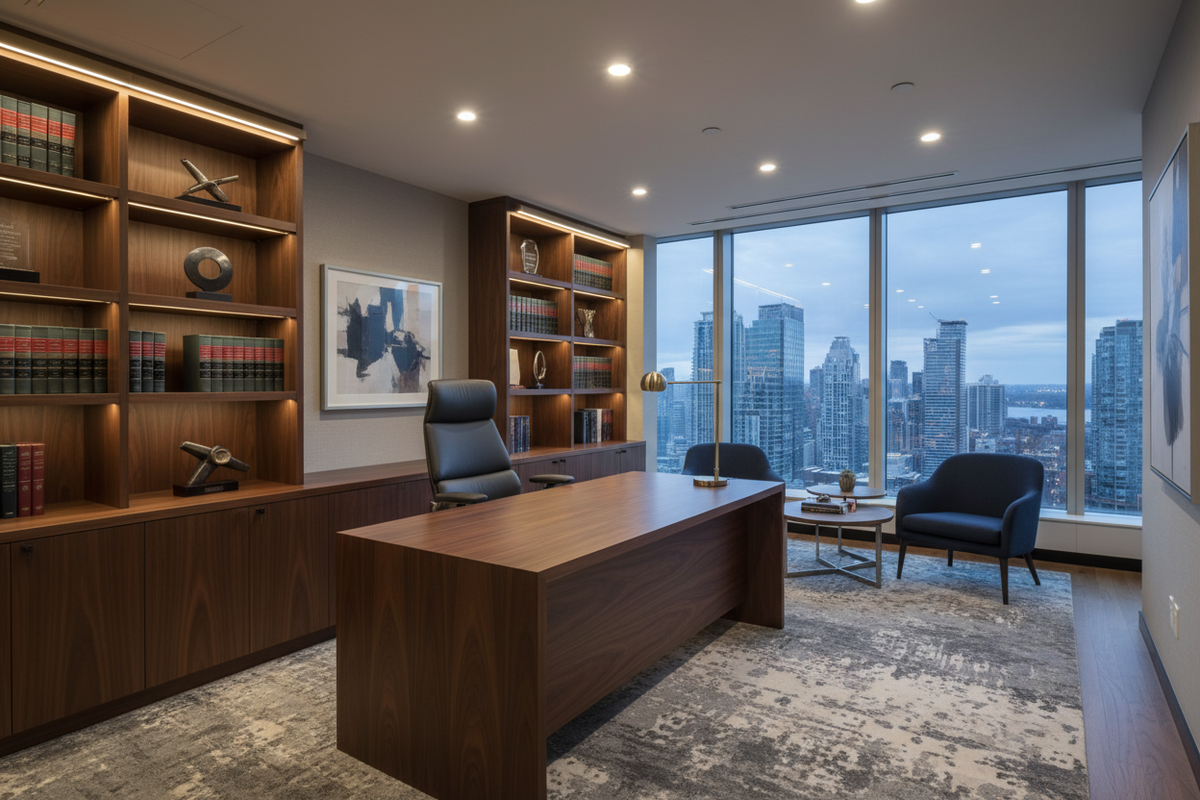
Furnishing a law firm means solving for two things at once: a workspace that handles confidential, document-heavy work, and a setting that signals credibility to clients from the moment they walk in. Reception and the boardroom carry the firm's gravitas, the lawyers' offices need privacy and storage, and the whole floor has to protect confidential conversations and files. This guide walks Ontario law firms, from a two-partner practice to a mid-size firm, through furnishing each space with commercial-grade pieces that hold up and present well. It is written by Brant Business Interiors, a commercial furniture dealer that plans, supplies, and installs office furniture for professional firms across Ontario.
A law firm sits within professional services, and the broader picture of how we furnish that sector lives on our page for the professional services firms we serve. This guide is the law-specific deep dive: the rooms, the materials, the privacy, and the records storage that legal work in particular demands.
What makes a law office different to furnish
Three things separate a law office from a generic professional office. First, appearance carries weight: a client deciding whether to trust a firm with a serious matter reads the reception and boardroom as evidence, so those rooms justify finishes a back office would not. Second, confidentiality is a professional obligation, not a preference, which makes acoustic privacy in offices and meeting rooms a functional requirement rather than a comfort. Third, the work is still document-heavy even in a digital practice: closing binders, original wills, real-estate files, and litigation records need secure, organised, and sometimes fire-rated storage. Furnish for those three and the rest of the office follows.
Room by room: furnishing a law firm
A law firm breaks into a handful of distinct spaces, each with its own furniture brief. The table sets them out with what each needs and the considerations that matter most. Treat the pieces named as common patterns rather than a fixed list; the right specification depends on the firm's size, practice areas, and budget.
| Space | Core furniture | What matters most |
|---|---|---|
| Reception | Reception desk, guest seating, display storage | First impression; calm, credible, comfortable wait |
| Lawyer / partner offices | Executive desk and credenza, executive chair, guest chairs | Privacy, gravitas, storage within reach |
| Boardroom | Conference table, conference seating, credenza | Presentation, acoustics, durable client-facing finish |
| Associate / support workstations | Desks or benching, task seating, pedestals | Productivity, durability, organised storage |
| File and records room | Lateral and vertical files, fire-rated storage | Security, capacity, legal-format filing |
The partner's office is the anchor of the brief because it does the most jobs at once: a working desk, a place to meet a client privately, and a quiet signal of seniority. A high-back executive synchro-tilter rated for multi-shift use, rated to 350 pounds with a synchro mechanism and GREENGUARD Gold certification, is the kind of seat that earns a partner office, paired with a desk and credenza in a finish that reads as substantial. Reception and the boardroom carry the firm's public face and reward investment in the seating and tables a client actually touches, while the associate floor can be furnished for productivity and durability without the same finish premium.
Materials and finishes for a credible firm
The materials are where a law office reads as serious or generic, and the choices trade off cost, durability, and impression. The table sets the common options against where each fits in a firm.
| Material | Reads as | Best for |
|---|---|---|
| Thermally fused laminate | Clean, durable, cost-effective | Associate offices, support, file room |
| Wood veneer / premium laminate | Warm, traditional, substantial | Partner offices, boardroom, reception |
| Glass and metal | Modern, transparent, light | Contemporary firms, meeting fronts |
| Bonded leather and high-grade textile | Comfortable, professional, wipeable | Executive and client seating |
Client-facing seating is where the leather-or-fabric decision pays off most. A bonded-leather guest chair, with a black bonded-leather seat and back over a steel frame and GREENGUARD Gold certification, gives a boardroom or partner office a finish that looks the part and wipes clean between meetings. Whether a firm leans traditional with veneer and leather or modern with laminate and glass is a brand decision; the constant is that the client-facing pieces deserve the better finish, and a multi-line dealer can match a single scheme across reception, offices, and the boardroom so the firm reads as one identity rather than three catalogues.
Privacy and acoustics: a professional requirement
Confidentiality runs through everything a law firm does, so acoustic privacy is part of the furniture brief, not an afterthought. Conversations in an office or a meeting room should not carry, and an open associate area still needs screening so calls and discussions stay contained. The table sets the common privacy needs against the furniture solutions that address them.
| Need | Solution | Where it applies |
|---|---|---|
| Confidential client meetings | Enclosed offices and meeting rooms, solid doors | Partner offices, boardroom, consult rooms |
| Speech privacy in the open | Acoustic screens, felt panels, ceiling baffles | Associate and support workstations |
| Desk-level screening | Desk-mounted privacy panels and modesty panels | Shared or open desks |
| Visual privacy for documents | Lockable storage, screened sightlines | Anywhere files are handled |
Acoustic separation is mostly an architectural job, walls, doors, and treatment, but furniture carries real weight in the open areas, where felt screens and panel-mounted dividers keep a working floor from broadcasting a phone call. The point is to treat privacy as a design requirement from the start, because retrofitting it after a firm has moved in is harder and more expensive than planning it.
Records and document storage
Even a paperless-leaning practice keeps originals, closing binders, and active files that need secure, organised storage in legal and letter formats. The table sets the common storage types against what each is for.
| Storage type | Best for | Notes |
|---|---|---|
| Lateral file cabinet | High-capacity active filing | Wide drawers, letter or legal, lockable |
| Vertical file cabinet | Deep filing in a small footprint | Letter or legal width, anti-tip, lockable |
| Fire-rated cabinet | Originals, wills, irreplaceable records | Rated protection for documents and media |
| Mobile pedestal | Personal active files at the desk | Box and file, locking, fits under the surface |
For active records, a welded-steel lateral file built from fully welded reinforced steel with full-extension ball-bearing drawers and an interlock that prevents more than one drawer opening at once gives a firm secure, high-capacity filing that survives daily use. Where the firm files in legal format, a four-drawer letter or legal vertical file with a cam lock and anti-tip mechanism stores deep in a small footprint, and for originals and wills a fire-rated cabinet adds a layer of protection that ordinary steel does not. The discipline is to match the storage to the document: active to lateral and vertical, irreplaceable to fire-rated.
Solo, small, and growing firms
The brief scales with the firm, and most Ontario law practices are small, so the spend should be concentrated where it earns its keep. A solo or two-partner practice that meets clients in its own space gets the most from investing in one credible meeting setting and a presentable office, while running the working areas on clean, durable laminate; the client never sees the back office, but they always see where they sat. A small firm taking its first dedicated space benefits from planning for the next few years rather than only today, since a layout that can absorb an extra associate or a second meeting room without a rebuild saves a disruptive move later. A growing mid-size firm shifts the priority toward consistency and reconfigurability: a coherent finish family across many offices, standardised associate workstations that are simple to add to and service, and storage that scales with the caseload.
Across all three, the advantage of working with a multi-line dealer is matching the spend to the firm's stage. A solo practice does not need the same specification as a thirty-lawyer firm, and a dealer that carries several Canadian manufacturers can put a partner-grade chair and a credible boardroom where they matter while furnishing the rest sensibly, all on one plan, one quote, and one Ontario-wide delivery and installation.
Where Brant Business Interiors fits
We furnish professional firms across Ontario, and a law office is a brief we know well: the gravitas of reception and the boardroom, the privacy and storage of the partner offices, and the durable productivity of the associate floor, planned as one scheme. That starts with a free design consultation, where we plan the space, match a single finish family across the client-facing rooms, specify the seating, storage, and tables, and deliver and install across Ontario with one point of contact for service. Because we carry many Canadian manufacturers rather than one line, we can put the better finish where clients see it and the value finish where they do not, all on one quote and one delivery. We are a family business furnishing Ontario offices since 1964, and for our public-sector clients we are also registered under our parent legal entity, Brant Basics, as an authorized OECM Supplier Partner under Agreement 2025-470. If you are opening, moving, or refreshing a firm, that is the conversation to start.
Frequently Asked Questions
What furniture does a law firm need?
A law firm typically needs a reception desk and guest seating, executive desks, credenzas, and chairs for partner and lawyer offices, a conference table and seating for the boardroom, desks or benching and task chairs for associates and support staff, and secure storage including lateral and vertical files and often a fire-rated cabinet. The client-facing rooms justify a better finish, while the working areas prioritise durability and storage.
How do I make a law office look professional?
Concentrate the better finishes where clients see them, in reception, the boardroom, and partner offices, using wood veneer or premium laminate, substantial desks, and quality client seating such as bonded leather. Keep a single, coherent finish family across those rooms so the firm reads as one identity. The associate and support areas can use clean, durable laminate without the same finish premium, which keeps the overall budget sensible.
How do law firms handle confidentiality in office design?
Confidentiality is a professional obligation, so privacy is built in rather than added on. Partner offices and meeting rooms are enclosed with solid doors for confidential conversations, open associate areas get acoustic screens, felt panels, or ceiling baffles for speech privacy, and files are kept in lockable storage with screened sightlines. Planning privacy from the start is far easier than retrofitting it after the firm has moved in.
What storage does a law firm need for records?
Active files suit high-capacity lateral cabinets or space-saving vertical cabinets in letter or legal format, both lockable and anti-tip. Original documents, wills, and irreplaceable records belong in a fire-rated cabinet for added protection, and lawyers keep personal active files in a locking mobile pedestal at the desk. The rule is to match the storage to the document: active to standard filing, irreplaceable to fire-rated.
Should a law office be modern or traditional?
Both work; it is a brand decision. A traditional firm signals heritage and trust with wood veneer, substantial desks, and leather seating, while a modern firm signals a contemporary, efficient practice with laminate, glass, and lighter finishes. What matters more than the style is consistency and quality in the client-facing spaces, since reception and the boardroom carry the firm's credibility regardless of which direction it chooses.
Is commercial-grade furniture necessary for a law firm?
Yes, for anything in daily use. Commercial-grade furniture is built and tested to standards such as ANSI/BIFMA for the duty cycle of an office, so executive chairs, task seating, and filing hold up to years of constant use where home-grade pieces would not. It also presents better and lasts longer, which matters in a client-facing business where worn furniture undercuts the impression the firm is trying to make.
The bottom line
Furnishing a law firm comes down to three jobs: present credibly to clients, protect confidential work, and store documents securely, with the better finishes concentrated where clients see them. Plan it as one scheme, treat privacy and records as requirements rather than extras, and specify commercial-grade pieces that hold up and present well. Brant Business Interiors plans, supplies, and installs furniture for professional firms across Ontario. Request a Quote or call 1-800-835-9565 to start with a free design layout.
This article is provided for general informational purposes only and does not constitute legal, financial, procurement, or other professional advice. Pricing and specifications reflect publicly available manufacturer information and Canadian market data and are subject to change without notice. Brant Business Interiors makes no representations or warranties, express or implied, as to the accuracy, completeness, or currency of this content. For details specific to your project, please contact us for a quote or consultation.Published June 5, 2026.