

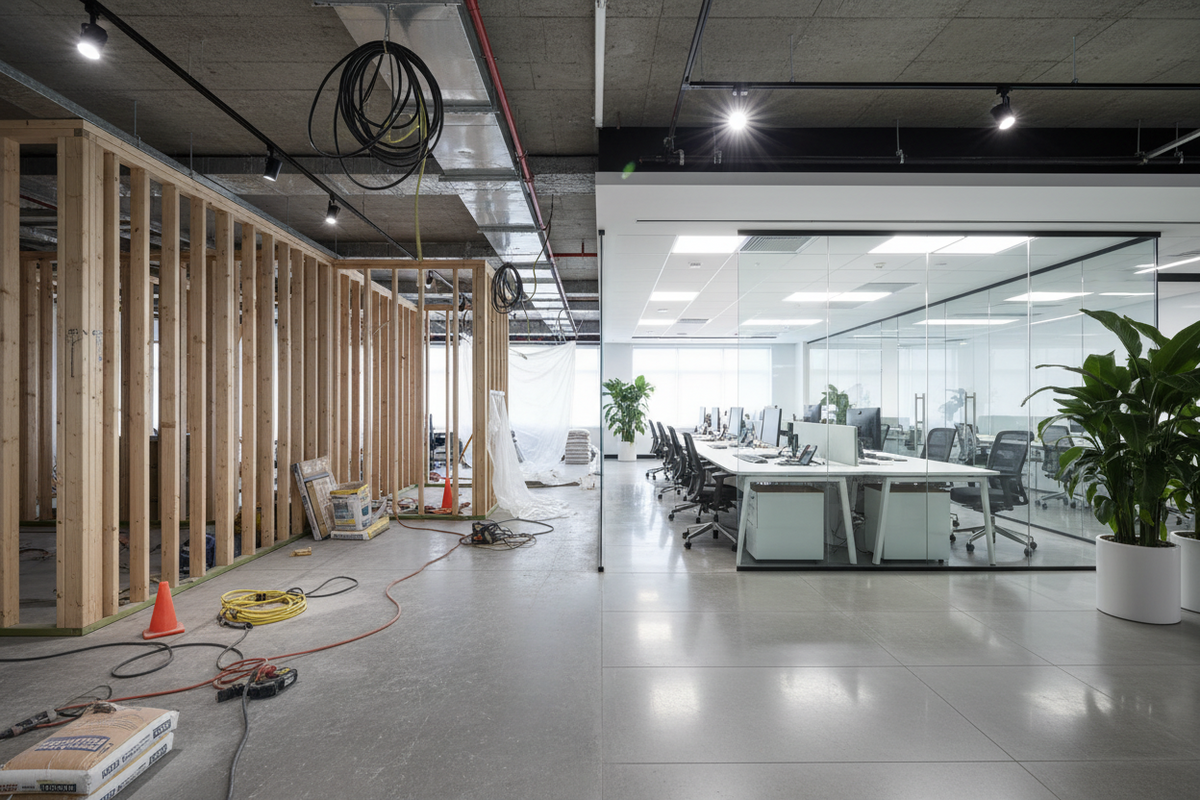
An office fit-out is the project of turning a bare or dated space into a working office: design, construction, furniture, and installation, typically running three to six months from brief to move-in and costing well into the hundreds of dollars per square foot in Ontario once everything is counted. A renovation is the same work on an existing office rather than a shell. Either way, the project succeeds or fails on sequence and coordination, not on any single choice, which is why understanding the phases, the realistic timeline, the budget ranges, and who handles what matters more than picking a paint colour. This guide walks Ontario businesses through the fit-out journey end to end. It is written by Brant Business Interiors, a commercial furniture dealer that designs, supplies, and installs office furniture across Ontario as part of these projects.
One framing note. A fit-out has a planning stage that this guide summarises but does not replace: how much space you need and how to plan it have their own homes in our guide on how much office space you need per employee and our office space planning guide for Ontario businesses. This page is about the project that turns that plan into a finished, furnished, occupied office.
The fit-out journey, phase by phase
A fit-out is a sequence of phases that overlap at the edges but must broadly happen in order. Rushing or skipping one is the most common way projects run over on both time and cost. The table sets out the typical phases, what each involves, a realistic duration, and who leads it. Durations are common patterns for a small-to-mid Ontario office; a larger or more complex project runs longer.
| Phase | What happens | Typical duration | Who leads |
|---|---|---|---|
| 1. Brief and program | Define headcount, rooms, budget, and timeline | 2 to 4 weeks | Business with facilities lead |
| 2. Design and test-fit | Space plan, test-fit, look and feel, furniture concept | 3 to 6 weeks | Designer or dealer space planner |
| 3. Costing and approvals | Detailed quotes, permit drawings, sign-off | 3 to 6 weeks | Business with the project team |
| 4. Construction | Demolition, walls, electrical, mechanical, finishes | 6 to 12 weeks | General contractor |
| 5. Furniture and install | Manufacture, deliver, and professionally install | 4 to 8 weeks (overlaps construction) | Furniture dealer |
| 6. Move-in and snag | Relocate, commission, fix the punch list | 1 to 2 weeks | Business with the project team |
The most important scheduling fact in the whole table is that commercial furniture has a lead time, commonly four to eight weeks from order to delivery, and that lead time runs in parallel with construction rather than after it. Order the furniture late and a finished space sits empty waiting for desks. A dealer who is engaged during the design phase, not after the walls are up, is how the furniture arrives the week the trades finish rather than a month later.
What an office fit-out costs in Ontario
Fit-out cost is quoted per square foot, and Ontario sits at the higher end globally. Independent 2026 cost guides put Toronto among the most expensive markets: Cushman and Wakefield's 2026 guide reports Toronto fit-out costs around $204 per square foot, and JLL's 2026 guide puts the regional average for a medium-quality corporate fit-out near $295 per square foot with a typical range of roughly $230 to $375. Ontario-focused construction guidance notes national fit-out averages can start around $150 per square foot for a basic build, with major metros considerably higher. The table translates that into planning bands. These are third-party market figures for budgeting, not a Brant Business Interiors quote.
| Quality tier | Typical cost per sq ft | What it includes |
|---|---|---|
| Basic / light | About $150 to $200 | Cosmetic refresh, minimal walls, value finishes |
| Medium / standard | About $200 to $300 | Reconfigured plan, meeting rooms, mid finishes |
| High / premium | About $300 to $375 and up | Custom build, premium finishes, feature spaces |
| Furniture (separate line) | A distinct portion of the total | Workstations, seating, storage, reception, boardroom |
Two things to hold onto about the budget. First, furniture is its own line item, separate from construction, which is why a furniture dealer quotes the furniture package independently of the general contractor's build cost. Second, the per-square-foot figure scales with how much construction you do: a renovation that keeps the existing walls and mainly refreshes finishes and furniture lands far lower than a full fit-out of a bare shell. Knowing which project you are running is the first step to a realistic budget.
Who handles what
A fit-out involves several specialists, and confusion about who owns which piece is a frequent source of delay and finger-pointing. The table sets out the common division of responsibility across the three main players. On smaller projects one party may wear more than one hat, but the responsibilities themselves do not disappear.
| Responsibility | Designer / architect | General contractor | Furniture dealer |
|---|---|---|---|
| Space plan and test-fit | Leads | Builds to it | Can lead furniture-led fit-outs |
| Permit and base-build drawings | Leads | Executes | Supports |
| Walls, electrical, finishes | Specifies | Leads | Coordinates power and data to furniture |
| Furniture selection and spec | Concept | Not involved | Leads |
| Delivery and installation | Not involved | Coordinates site access | Leads |
| Warranty and after-care | Not involved | Building defects | Furniture warranty and service |
For a furniture-led project, where the building shell is sound and the work is mainly reconfiguring and refurnishing, a multi-line dealer can run the planning and furniture end to end and coordinate with a contractor only for the trades. That is a common and cost-effective Ontario pattern for a growing company taking new space that does not need a full base-building rebuild.
The furniture package
The furniture is the part of the fit-out people actually touch every day, and specifying it from real products with verified dimensions is what keeps the plan honest. A finished office is built from a handful of categories, and pulling them from a multi-line catalogue lets each one be chosen for its job rather than forced into a single line. For casegoods and storage, a storage credenza at 72 by 24 inches gives a private office or a resource wall a known footprint, and for heavier records a steel multi-storage cabinet with a lifetime limited warranty combines shelving over a lateral file in one 36-inch unit. Private offices take a double-pedestal L-shaped desk at a 72 by 78 inch footprint, while the front of house is anchored by an L-shaped reception desk that presents the brand and handles visitors. Because Brant Business Interiors carries many Canadian manufacturers under one roof, including Global Furniture Group and its Offices to Go line, a single furniture package can mix casegoods, storage, seating, and reception to one budget and one delivery. Coordinating finishes across those pieces, so the laminate on the desks, the credenzas, and the reception desk reads as one scheme rather than three catalogues, is a detail a single point of contact handles that separate suppliers rarely do.
The pre-move checklist
The move itself is where good projects still go wrong, usually because something that needed weeks of lead time was left to the last fortnight. The table is a working pre-move checklist, with when each item should happen and why it matters.
| Task | When | Why it matters |
|---|---|---|
| Confirm furniture order | During construction, not after | Four-to-eight-week lead time runs parallel to the build |
| Book the loading dock and elevator | 3 to 4 weeks out | Downtown towers require scheduled, insured access |
| Plan IT and cabling | Before furniture install | Power and data must reach each workstation |
| Arrange old-furniture removal | 2 to 3 weeks out | The old office has to be cleared, not just the new one filled |
| Schedule professional install | As trades finish | Workstations and panels need assembly on site |
| Walk the punch list | Move-in week | Catch and fix snags while the team is still mobilised |
Keeping a fit-out on time and on budget
Most fit-out overruns trace back to a short list of avoidable causes, and knowing them in advance is the cheapest form of cost control. The biggest is scope creep during construction: every change after the drawings are approved is a change order, and change orders are where budgets quietly double. Locking the design and the furniture spec before the trades start, then treating mid-project changes as the exception, keeps the number you approved close to the number you pay. The second is the lead-time trap already noted: furniture and long-lead items such as glass fronts or specialty lighting ordered late either delay move-in or force expensive expedited shipping, so the saving is to order early, not cheap. The third is underestimating the existing conditions in a renovation, since opening a wall in an older Ontario building can reveal electrical or mechanical work that was not in the budget; a contingency of roughly ten to fifteen percent absorbs the surprises that a renovation almost always holds.
There are also legitimate ways to bring a fit-out down without cheapening it. Reusing or reconfiguring existing furniture that is still commercial-grade, rather than replacing everything, can take a meaningful slice off the furniture line. Choosing a furniture-led renovation over a full base-building rebuild avoids the most expensive trades entirely where the shell is sound. Standardising on a smaller palette of workstation and seating models lowers cost through volume and makes future reconfiguration and warranty service simpler. And phasing the work, doing the floor in zones while the team keeps working, spreads both the disruption and the spend. A dealer engaged early can advise on all of these because the furniture decisions interact with the construction decisions, which is the whole argument for not leaving furniture to the end.
Ontario and public-sector notes
A few Ontario realities shape a fit-out. Permits and inspections for construction work add time to phase three, which is why the approvals window is a real line on the schedule rather than a formality. Delivery and installation are Ontario-wide from a dealer like ours, with professional on-site installation of workstations and panel systems rather than flat-packed boxes, and with old-furniture removal handled as part of the job. For public-sector and broader public sector buyers furnishing a renovated space, the procurement path runs alongside the project: Brant Business Interiors is registered under our parent legal entity, Brant Basics, as an authorized OECM Supplier Partner under Agreement 2025-470, so eligible Ontario organisations can specify and purchase the furniture package through us without running a separate competitive process.
Where Brant Business Interiors fits
We are the furniture partner in the fit-out, engaged from the design phase so the furniture package is planned, ordered, and installed in step with the build rather than bolted on at the end. That begins with a free design consultation: we space-plan and test-fit, specify the furniture to the drawings, coordinate power and data with the trades, then deliver and install across Ontario and stay accountable for the furniture warranty and service afterward. On a full base-building rebuild, an architect and general contractor lead and we run the furniture scope; on a furniture-led renovation, we can carry the planning and furniture end to end. Either way, bringing the dealer in early is what keeps the furniture off the critical path. If you are planning a fit-out or a renovation, that is the conversation to start.
Frequently Asked Questions
How much does an office fit-out cost in Ontario?
Independent 2026 cost guides put Ontario at the higher end globally, with Toronto fit-out costs around $204 per square foot per Cushman and Wakefield, and a regional medium-quality average near $295 per square foot in a typical range of about $230 to $375 per JLL. A basic refresh can start nearer $150 per square foot, while a premium custom build runs higher. Furniture is a separate line item from the construction cost.
How long does an office fit-out take?
A small-to-mid Ontario office fit-out typically runs three to six months from brief to move-in, broken into briefing, design and test-fit, costing and approvals, construction, furniture and install, and move-in. Larger or more complex projects take longer. The single biggest schedule risk is ordering furniture late, since commercial furniture has a four-to-eight-week lead time that should run in parallel with construction.
What is the difference between a fit-out and a renovation?
A fit-out turns a bare or unfinished space, often a shell handed over by a landlord, into a working office, while a renovation upgrades or reconfigures an existing office. A renovation that keeps the walls and mainly refreshes finishes and furniture costs and takes less than a full fit-out of a shell. Knowing which project you are running is the first step to a realistic budget and timeline.
Who do I need for an office fit-out?
A typical fit-out involves a designer or architect for the space plan and permit drawings, a general contractor for the construction, and a furniture dealer for the furniture package, delivery, and installation. On smaller projects one party may cover more than one role, and a furniture-led renovation can be run largely by a multi-line dealer coordinating a contractor only for the trades.
When should I order furniture in a fit-out?
Order furniture during the construction phase, not after it, because commercial furniture commonly has a four-to-eight-week lead time that should overlap the build. Engaging the furniture dealer during design, so the package is specified to the drawings and ordered on time, is how the furniture arrives the week the trades finish rather than leaving a finished space sitting empty.
Can I just renovate without moving?
Often yes. A phased renovation can refresh finishes, reconfigure the layout, and replace furniture while the team stays in the building, working zone by zone. It is usually less disruptive and less expensive than a full relocation and fit-out, and it suits a business whose lease and location still work but whose space no longer fits how the team works.
The bottom line
An office fit-out is a sequenced project, brief, design, costing, construction, furniture, and move-in, that lives or dies on coordination and lead times rather than on any single decision. Budget for Ontario's higher-end per-square-foot costs, keep furniture on a parallel track so it is not the thing everyone waits for, and be clear about who owns each phase. Brant Business Interiors is the furniture partner that plans, supplies, and installs across Ontario, engaged early so the package lands on schedule. Request a Quote or call 1-800-835-9565 to start with a free design layout.
This article is provided for general informational purposes only and does not constitute legal, financial, procurement, or other professional advice. Pricing and specifications reflect publicly available manufacturer information and Canadian market data and are subject to change without notice. Brant Business Interiors makes no representations or warranties, express or implied, as to the accuracy, completeness, or currency of this content. For details specific to your project, please contact us for a quote or consultation.Published June 8, 2026.