

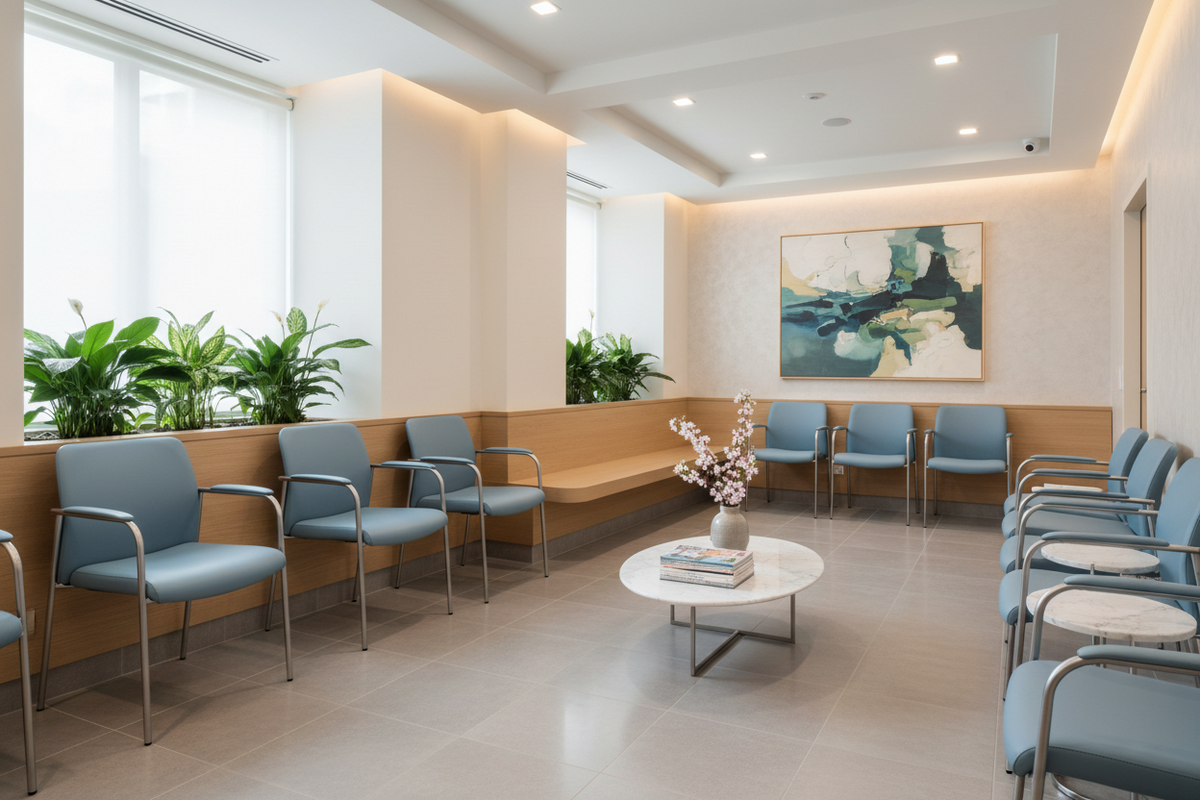
Furnishing a private medical or dental clinic comes down to three things: a waiting room that puts patients at ease, furniture with cleanable, easy-care surfaces that suit an infection-control routine, and seating that works for every patient who sits in it. A clinic is a healthcare space and a small business at once, so the furniture has to be durable and wipe-clean for daily disinfection while still feeling welcoming rather than institutional. This guide walks Ontario private practices, family medicine, dental, physiotherapy, and specialist clinics, through furnishing each area with commercial-grade pieces that hold up and clean up. It is written by Brant Business Interiors, a commercial furniture dealer that plans, supplies, and installs furniture for clinics and offices across Ontario.
This guide leads with the private practice rather than the hospital. The broader healthcare environments we furnish, from clinics to administrative and care settings, have their own home, and this page is the clinic-specific deep dive: the waiting room, reception, exam and treatment areas, and the cleanable surfaces a practice needs day to day.
What makes clinic furniture different
Three requirements separate clinic furniture from ordinary office furniture. First, surfaces have to stand up to repeated cleaning and disinfection, which rules out open-weave fabrics and bare wood in patient areas and favours wipeable vinyl, bonded leather, sealed laminate, and steel. Second, the waiting room sets the tone of the whole visit, so seating needs to be comfortable, supportive, and welcoming rather than clinical and cold. Third, the furniture has to suit every patient, which means a mix of seat widths, supportive arms that help people sit and stand, and options for larger or less mobile patients. Furnish for cleanability, comfort, and accessibility and the clinic both works and reassures.
Area by area: furnishing a clinic
A clinic divides into a handful of distinct areas, each with its own furniture brief. The table sets them out with the core furniture and what matters most in each. Treat the pieces named as common patterns rather than a fixed list; the right specification depends on the practice type, patient mix, and space.
| Area | Core furniture | What matters most |
|---|---|---|
| Waiting room | Patient seating, side tables, coat and magazine storage | Comfort, cleanability, accessible and varied seating |
| Reception and admin | Reception desk, task chairs, files and storage | Privacy at the desk, durable surfaces, secure records |
| Exam and treatment | Clinical stools, guest chairs, supply storage | Wipeable surfaces, height-adjustable stools, mobility |
| Consult / practitioner office | Desk, task chair, patient guest chairs | Privacy, comfort for difficult conversations |
| Support and records | Lockable cabinets, files, sterilization-area storage | Security, capacity, cleanable steel or laminate |
The waiting room earns the most attention because it is where patients form their impression and where cleanability matters most. A vinyl-upholstered guest chair with arms, finished in wipeable LuxPlus vinyl over a welded steel frame with chrome arms, gives the dual benefit a clinic needs: arms help older or less mobile patients sit and stand, and the vinyl wipes down between patients rather than absorbing what an open fabric would. For a flexible or overflow waiting area, a stacking upholstered guest chair that stacks several high lets a practice flex seating for a busy clinic day and clear the floor for cleaning. The exam room runs on a height-adjustable clinical stool with a pneumatic seat, foot ring, and a five-star base, which lets a practitioner move and adjust at the chairside.
Cleanability and infection control
Cleanability is the single requirement that most distinguishes clinic furniture, and it is decided by the surface material more than anything else. A wipeable, non-porous surface can be disinfected on a clinic's cleaning schedule, while an open fabric or an unsealed surface cannot. The table sets the common surface materials against how they clean and where they fit.
| Surface material | Cleanability | Best for |
|---|---|---|
| Vinyl upholstery | Wipeable and non-porous; disinfects easily | Waiting and patient seating, exam areas |
| Bonded leather | Wipeable; professional finish | Consult offices, premium patient seating |
| Sealed laminate | Wipeable hard surface | Reception desks, worksurfaces, casegoods |
| Powder-coated steel | Wipeable and durable | Storage, files, stool and chair frames |
| Open-weave fabric | Hard to disinfect; avoid in patient areas | Staff-only, low-touch areas at most |
Two honest notes on cleanability. First, specify the surface to the use: patient-contact seating should be vinyl or bonded leather, not open fabric, and worksurfaces and storage should be sealed laminate or steel. Second, where a practice needs more than wipeable surfaces, such as healthcare-grade upholstery with moisture barriers or specific antimicrobial finishes, those are manufacturer options to confirm by line rather than assumptions; a multi-line dealer can source the right healthcare upholstery program and confirm the specification rather than guessing. The base rule holds regardless: in patient areas, choose a surface you can actually disinfect.
Seating for every patient
Patient seating has to suit a wide range of people, which makes it the most considered choice in the clinic. The table sets the common seating types against where each belongs and the spec that matters.
| Seating type | Where it belongs | Key specification |
|---|---|---|
| Waiting room chair with arms | General waiting areas | Wipeable surface, supportive arms, sturdy frame |
| Stacking guest chair | Flexible or overflow waiting | Stacks for cleaning, wipeable, durable |
| Bariatric / wide seat | Inclusive waiting and patient areas | Higher weight capacity, wider seat |
| Clinical stool | Exam and treatment rooms | Height-adjustable, foot ring, mobile base |
| Staff task chair | Reception and admin | Ergonomic, wipeable, all-day comfort |
Accessibility is the point that turns a waiting room from adequate to genuinely welcoming. Supportive arms help patients with limited mobility, a mix of seat widths including at least some higher-weight-capacity and wider seats makes every patient comfortable, and firmer, higher seats are easier to rise from than low soft lounge chairs. None of this is exotic; it is a matter of specifying the range deliberately rather than buying one chair for everyone, and it is exactly the kind of thoughtful mix a clinic-experienced dealer plans in from the start.
Two further seating choices come up often enough to plan for from the start. The first is patient weight capacity: a standard commercial chair is typically rated in the range of 250 to 300 pounds, while bariatric models are built wider and to higher capacities, so a waiting room serving the general public should carry at least a few higher-capacity seats and confirm the exact rating by product line rather than assume it. The second is durability under constant turnover. A busy waiting room cycles through far more sit-and-stand events than an office chair ever sees, so beam or ganged tandem seating, with several seats on a shared steel beam, holds its alignment, leaves clear floor for cleaning underneath, and stands up to the traffic better than loose chairs in a high-volume practice. For behavioural-health or higher-acuity rooms, tamper-resistant, weighted, or otherwise specified seating may be required; these are manufacturer options to confirm by line rather than assumptions. The common thread is to match the seat to how hard the room works, and a clinic-experienced dealer specifies that capacity, durability, and finish mix up front.
Furniture priorities by clinic type
Different practices weight the brief differently, so the furniture follows the clinical work. The table gives the common priorities by clinic type as a starting point.
| Clinic type | Furniture priorities |
|---|---|
| Family medicine | Comfortable mixed waiting seating, exam stools, secure records |
| Dental | Welcoming reception, wipeable surfaces throughout, sterilization storage |
| Physiotherapy / rehab | Durable high-traffic seating, accessible and bariatric options |
| Specialist / consult | Private consult offices, premium patient seating, calm waiting |
Across every type, secure storage is a constant: clinics handle confidential records and supplies, so lockable cabinets and files in cleanable steel or sealed laminate belong in the support areas regardless of speciality. A lockable steel storage cabinet at 36 by 18 by 72 inches with four shelves, two hinged doors, and a standard lock, in a wipeable powder-coated finish, gives a sterilization or supply room secure, cleanable storage that an open shelf cannot, and a vertical or lateral file in steel keeps patient records locked and organised in letter or legal format. A practice opening or refreshing its space gets the best result by matching the seating mix and the storage to its actual patient flow rather than buying a generic package.
New furniture and the honest cost question
Clinics watch budgets closely, and the temptation to buy used or consumer-grade furniture is real. The honest position is that patient-area furniture is the wrong place to economise on grade, because a chair that is disinfected several times a day and sat in by hundreds of patients a month needs a commercial duty cycle and a surface that survives repeated cleaning; a home-grade chair fails on both. Commercial-grade furniture tested to standards such as ANSI/BIFMA is built for that load, and choosing it new means a known surface, a warranty, and a clean starting point rather than an unknown history in a setting where cleanliness is the whole point. Where budget is tight, the better lever is to specify carefully, putting the spend on the patient-contact and high-traffic pieces and economising on staff-only areas, rather than dropping the grade where patients sit.
Where Brant Business Interiors fits
We furnish private clinics and practices across Ontario, and a clinic is a brief we plan as a whole: a welcoming, cleanable waiting room, a private and durable reception, exam and treatment areas with the right stools and wipeable seating, and secure storage for records and supplies. That starts with a free design consultation, where we plan the space, specify cleanable surfaces and an accessible seating mix, and deliver and install across Ontario with one point of contact for service. Because we carry many Canadian manufacturers rather than one line, we can match wipeable patient seating, clinical stools, casegoods, and storage to your practice and budget on one quote and one delivery. We are a family business furnishing Ontario spaces since 1964, and we also serve the public health sector as a supplier registered under our parent legal entity, Brant Basics, as an authorized OECM Supplier Partner under Agreement 2025-470. If you are opening, relocating, or refreshing a clinic, that is the conversation to start.
Frequently Asked Questions
What furniture does a medical or dental clinic need?
A clinic typically needs comfortable, cleanable waiting room seating, a reception desk with task seating and secure files, exam and treatment furniture including height-adjustable clinical stools and wipeable guest chairs, private consult offices, and lockable storage for records and supplies. The patient-contact pieces should use wipeable surfaces such as vinyl or bonded leather, and the seating mix should include accessible and higher-capacity options.
What makes furniture suitable for infection control?
The deciding factor is a wipeable, non-porous surface that can be disinfected on the clinic's cleaning schedule, such as vinyl upholstery, bonded leather, sealed laminate, or powder-coated steel. Open-weave fabrics and unsealed surfaces are hard to disinfect and are best avoided in patient areas. Where a practice needs healthcare-grade upholstery with moisture barriers or specific antimicrobial finishes, those are manufacturer options to confirm by product line rather than assume.
What is the best seating for a clinic waiting room?
The best waiting room seating is comfortable, has supportive arms that help patients sit and stand, and uses a wipeable surface such as vinyl. A good waiting area mixes seat types, including some wider or higher-weight-capacity chairs for accessibility and firmer higher seats that are easier to rise from than low lounge chairs. Stacking chairs add flexibility for busy days and make cleaning the floor easier.
Do clinics need bariatric or accessible seating?
Yes. An inclusive waiting room includes some higher-weight-capacity and wider-seat chairs so that every patient has a comfortable, safe place to sit, alongside chairs with supportive arms for patients with limited mobility. Planning the seating mix deliberately, rather than buying a single chair for everyone, is what makes a clinic genuinely accessible, and a dealer can source bariatric-rated options to suit the patient mix.
Should a clinic buy new or used furniture?
For patient-area and high-traffic furniture, new commercial-grade is the sound choice, because seating that is disinfected daily and used by hundreds of patients a month needs a commercial duty cycle and a clean, known surface rather than an unknown history. Commercial-grade furniture tested to standards such as ANSI/BIFMA is built for that load and comes with a warranty. Where budget is tight, the better saving is to specify carefully by area, not to drop the grade where patients sit.
How do I make a clinic feel welcoming rather than clinical?
Comfort and warmth come from the seating and the finishes, not from spending more on equipment. Supportive, well-cushioned waiting chairs in warm vinyl or bonded leather tones, a calm and uncluttered reception, and a coherent finish family across the patient areas make a clinic feel cared-for while still being fully cleanable. The goal is a space that reassures patients while meeting every cleaning and accessibility requirement.
The bottom line
Furnishing a private clinic means choosing cleanable surfaces patients and staff touch, seating that welcomes and suits every patient, and secure storage for records and supplies, all in commercial-grade pieces that survive daily disinfection. Specify the surface to the use, build an accessible seating mix, and put the budget where patients sit. Brant Business Interiors plans, supplies, and installs furniture for clinics and practices across Ontario. Request a Quote or call 1-800-835-9565 to start with a free design layout.
This article is provided for general informational purposes only and does not constitute legal, financial, procurement, or other professional advice. Pricing and specifications reflect publicly available manufacturer information and Canadian market data and are subject to change without notice. Brant Business Interiors makes no representations or warranties, express or implied, as to the accuracy, completeness, or currency of this content. For details specific to your project, please contact us for a quote or consultation.Published June 14, 2026.