

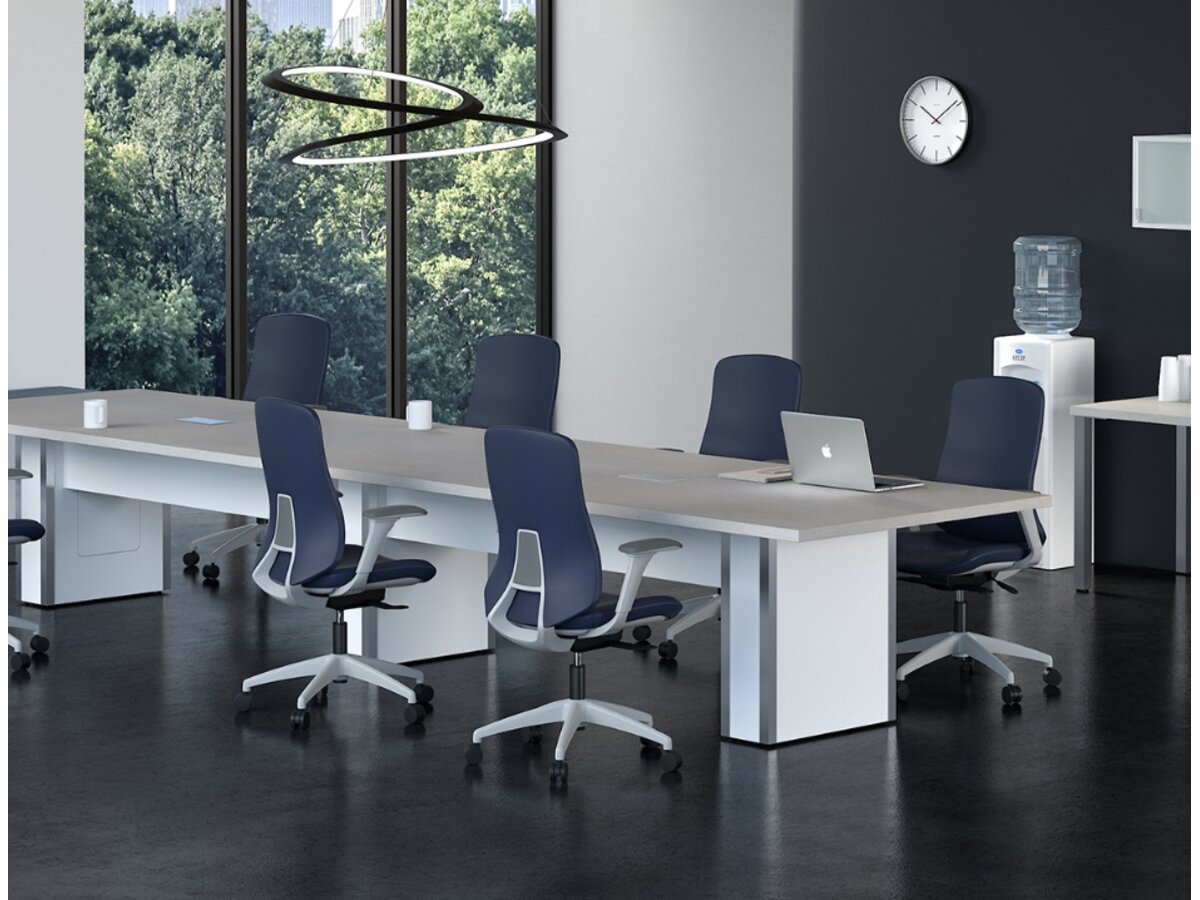
For most Canadian businesses furnishing a permanent office, buying commercial-grade furniture beats leasing it, because furniture is a durable asset that lasts well beyond a typical lease term. Leasing and renting earn their place in narrower cases: a short sublease, a pop-up or staging, or a deliberate choice to protect cash. This is the 2026 guide to lease versus rent versus finance versus buy for an Ontario business, with the Canadian tax and cash-flow angles the cross-border articles miss, a top pick worth owning, and how to buy without paying for everything up front.
Brant Business Interiors, a family-owned division of Office Central Inc., in business since 1964, sells new commercial furniture rather than renting it, so our recommendation favours ownership. We have still laid out where leasing genuinely wins, because steering you wrong helps no one. None of the below is tax advice; confirm the specifics with your accountant.
Four ways to acquire office furniture
The decision is not simply lease or buy. There are four common routes, and they suit different situations.
| Option | Upfront cost | Who owns it | Total cost over 7–10 years | Best for |
|---|---|---|---|---|
| Buy outright | Highest | You, from day one | Lowest for furniture you keep | A permanent office and durable, commercial-grade pieces |
| Finance the purchase | Low; spread into payments | You (you are buying, just over time) | Purchase price plus interest | Owning without the one-time cash hit |
| Lease | Low; deposit plus payments | The lessor, unless lease-to-own | Often higher than buying once the term runs | Conserving credit, or matching a fixed space lease |
| Rent (short term) | Lowest per month | The rental company | Highest if kept long | Pop-ups, staging, subleases, temporary teams |
Why buying usually wins for furniture
The lease-versus-buy logic that applies to fast-depreciating technology does not transfer cleanly to furniture. A laptop is obsolete in three years; a commercial-grade desk or task chair is built to serve for ten or more. The Business Development Bank of Canada puts the trade-off plainly: buying is usually cheaper over the life of the asset, while leasing requires less cash upfront and puts less strain on cash flow. When the useful life of the asset is long, paying monthly forever, or paying a lease premium for a few years and handing it back, costs more than owning it. Rental and lease pieces also tend to be standard, lighter-duty stock rather than the commercial-grade furniture you would choose to keep, so you can end up paying ongoing money for furniture you would never have bought. For a permanent office, ownership of durable, third-party-rated furniture is almost always the lower total cost.
When leasing or renting genuinely makes sense
There are real cases where not owning is the smarter move, and they are mostly about time and cash rather than the furniture itself.
- Short or uncertain space lease. If you are subletting or on a one-to-two-year term, matching the furniture commitment to the space can make sense.
- Pop-ups, staging, and events. A temporary location or a staged office for sale or show is exactly what short-term rental exists for.
- A bridge while you grow. A fast-scaling team that will reconfigure within a year may rent to avoid buying twice.
- Protecting credit or cash deliberately. Some businesses keep furniture off the balance sheet or preserve a credit line for other priorities.
Outside those cases, the monthly-payment appeal of leasing usually fades once you add up the term against a piece you would have kept anyway.
The Canadian tax and cash-flow angle
This is where the cross-border articles mislead Canadian buyers, because they quote United States or Australian rules. In Canada, office furniture you buy is generally a capital asset in Capital Cost Allowance Class 8, which is depreciated at twenty percent on a declining-balance basis, so you write off the cost over several years rather than all at once. Lease payments are typically treated as a current operating expense instead. Which is better for your tax position depends on your income, your cash flow, and your accountant's read of your situation, so this is a question to put to them rather than to a furniture company. The point for the buy-versus-lease decision is that owning does not mean losing the deduction; it means claiming it differently over time.
The most common real reason businesses lease is cash flow, not tax: they do not want a large one-time outlay. That problem has a cleaner answer than leasing furniture you will pay for several times over.
Buy without the upfront hit: financing and purchase orders
If the only thing pushing you toward a lease is the cash, financing the purchase, through your own bank or an equipment-finance provider, keeps the ownership advantage while spreading the cost. Several Ontario dealers, including atWork, now offer furniture leasing or financing arrangements, and finance specialists such as Fincap and the BDC fund equipment purchases for businesses, so the option to spread payments while still owning the furniture is widely available. You end up owning durable, commercial-grade furniture and you avoid the lease premium and the hand-it-back ending. Brant Business Interiors is purchase-order friendly, so business and institutional buyers can plan a full fit-out around their budget cycle, and for Ontario public-sector buyers our registration under our parent legal entity, Brant Basics, as an authorised OECM Supplier Partner under Agreement 2025-470 can simplify the process. Tell us the project and we will quote the furniture so you can line up the payment structure that suits you.
Our top pick to own, not rent (commercial-grade, Ontario-stocked)
The case for owning is easiest to see in the pieces that last longest. A rented desk is gone in a year; a commercial casegood serves a decade.
- Our #1 pick: an L-shaped desk with double pedestals. A Global L-shaped workstation with a thermally fused laminate top and two locking pedestals for storage, certified to GREENGUARD and tested to ANSI/BIFMA. It is exactly the kind of durable, third-party-rated asset that is cheaper to own than to rent twice, and it anchors a private office or a manager's workstation for years.
- Pair it with seating you keep: commercial-grade task chairs rated to BIFMA outlast the lighter stock that fills rental fleets, so the whole workstation is an asset rather than a recurring bill.
Buy the right quantity once with a free design layout, and the case for owning gets stronger still: the right commercial-grade office desks and task chairs, planned, installed, and owned, cost less over a decade than the same office rented twice.
Frequently Asked Questions
Is office furniture tax deductible for a business in Canada?
Yes, but usually not all in one year. Furniture you buy is generally a capital asset in Capital Cost Allowance Class 8, written off at twenty percent on a declining-balance basis over several years, while lease payments are typically a current operating expense. Which helps your business more depends on your situation, so confirm the treatment with your accountant. This is general information, not tax advice.
What are the disadvantages of leasing office furniture?
Over a full term, leasing often costs more than buying a durable asset, you may need a deposit or payments in advance, you can be locked into an agreement that is hard to exit, and you do not own anything at the end unless it is a lease-to-own. Leased and rented stock also tends to be lighter-duty than the commercial-grade furniture you would choose to keep.
Is buying office furniture a business expense or an asset?
For furniture that lasts more than a year, it is generally treated as a capital asset and depreciated over time rather than expensed all at once, while leasing or renting is usually a straight operating expense. The label matters for your taxes, so your accountant should confirm how to record it; either way, owning durable furniture is normally the lower total cost.
Can a business finance an office furniture purchase instead of leasing?
Yes, and it is often the better answer when the obstacle is cash rather than the desire to own. Financing spreads the cost into payments while you still end up owning the furniture, avoiding the lease premium and the return-it ending. You can arrange financing through your bank or an equipment-finance provider, and Brant Business Interiors is purchase-order friendly, so you can own a full fit-out without the one-time outlay.
When does renting office furniture actually make sense?
When the need is temporary or the space is uncertain: a pop-up, a staged office, an event, a short sublease, or a fast-scaling team that will reconfigure within a year. In those cases matching a short furniture commitment to a short time horizon is sensible. For a permanent office, buying commercial-grade furniture is normally the lower-cost choice.
The bottom line
For a permanent office and furniture you will keep, buy commercial-grade and own it; finance the purchase if the cash timing is the issue. Lease or rent when the need is genuinely short term or the space is uncertain. Our top pick to own is a durable Global L-shaped desk that outlives any lease. The decision is really about how long you will keep the furniture and how you want to handle the cash, not about chasing a monthly payment that quietly costs more. Tell us your project and your budget timing. Request a Quote or call 1-800-835-9565, and ask about a free design consultation.
This article is provided for general informational purposes only and does not constitute legal, financial, procurement, or other professional advice. Pricing and specifications reflect publicly available manufacturer information and Canadian market data and are subject to change without notice. Brant Business Interiors makes no representations or warranties, express or implied, as to the accuracy, completeness, or currency of this content. For details specific to your project, please contact us for a quote or consultation.Published June 4, 2026.