

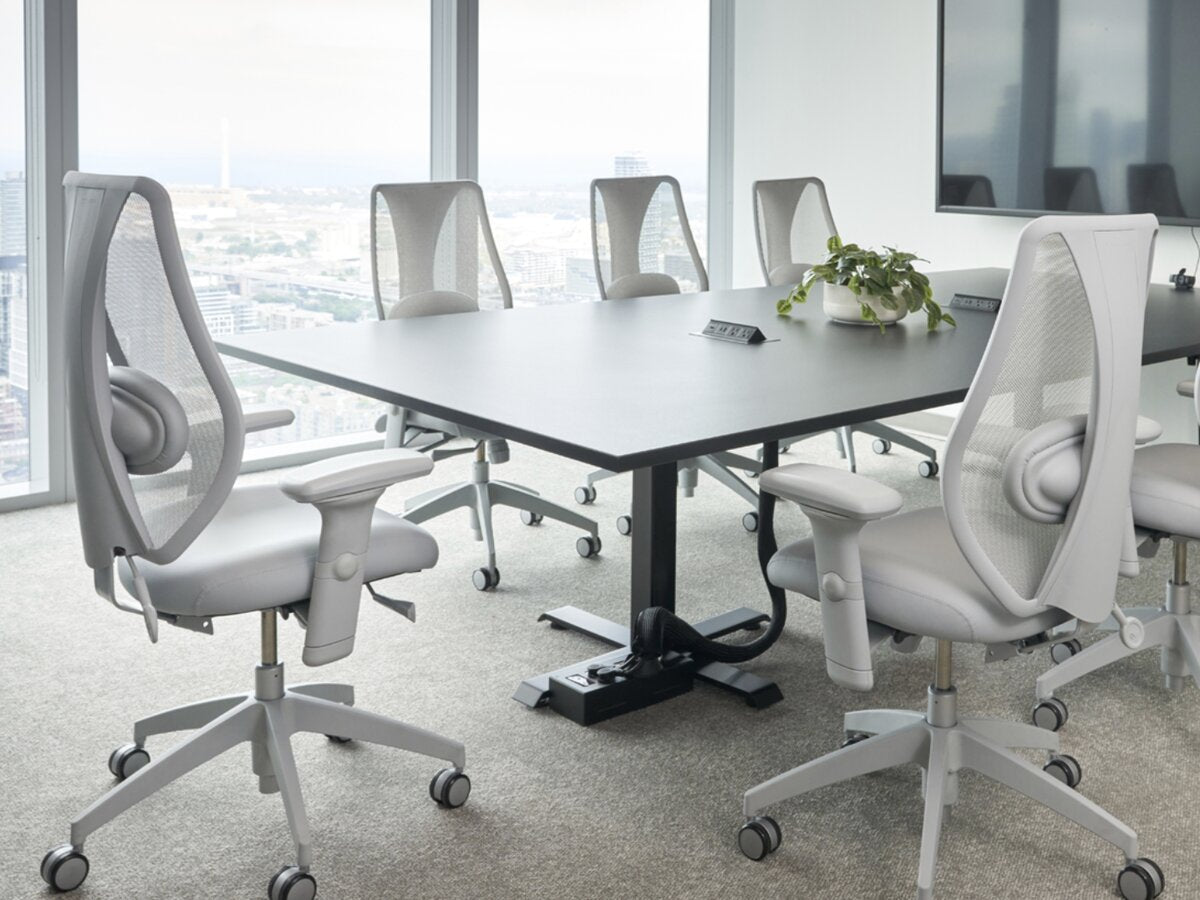
Planning an office layout is never really about the floor plan. It's about how your team actually works. Most Ontario businesses and institutions start a refurnish the same way: someone measures the room, counts the desks, and orders what fits. Six months later the open area is too loud for focus work, the one meeting room is always booked, and the new hires are squeezed into a corner that was never meant to hold them. The plan didn't fail because of the furniture. It failed because the layout was drawn around the room instead of around the work.
This guide is the practical version for an Ontario office or facility manager: what office space planning actually involves, how much space your team genuinely needs (with the Canadian benchmark), the four layout patterns and who each one suits, a seven-step workflow from first measurement to install, and the mistakes that cost the most to fix later. It's written for the person who has to make the room work (a school board's admin office, a growing professional-services firm, a family health team, a municipal department), not for a home office.
What office space planning actually is
Office space planning is the discipline of matching a physical workspace to the way a team operates: how many people use it, what kind of work they do, how often they're in, and how the space needs to flex as the organisation changes. It covers the headcount the space can hold, the mix of focus and collaboration areas, circulation (the room to move between things), storage, and the furniture that makes each zone do its job.
What it isn't is interior decorating, and it isn't a drawing exercise you finish before you think about furniture. The layout and the furniture decisions are the same decision. A benching system, a private office, and a hot-desk neighbourhood put very different demands on the same square footage. Plan the work first, choose the furniture that supports it, and the floor plan follows.
How much space do you actually need?
The most common question, and the one Google surfaces first, is how many people fit in the space I have? The honest answer is that it depends on how your team works, but there is a Canadian benchmark to start from. The Canadian Centre for Occupational Health and Safety (CCOHS), citing the Government of Manitoba's Office Space Planning Standards, puts a single staff workstation at about 6.7 square metres (72 square feet), roughly an 8 × 9 ft footprint, whether the desk is open or enclosed.
That's the per-desk number. The whole-office number is larger because you're also paying for circulation, meeting rooms, reception, storage, and breakout space. Commercial-real-estate planners commonly cite an average-density range of roughly 150–250 square feet per person all-in for a conventional mixed office, and about 20–25 square feet per seat for a meeting room. As a planning starting point:
| Space type | Typical planning range per person/unit | Notes |
|---|---|---|
| Individual workstation | ~6.7 m² / 72 ft² for a staff desk | CCOHS / Govt of Manitoba standard; enclosed offices run larger |
| Whole office, assigned desks | ~14–23 m² / 150–250 ft² per person, all-in | Commonly cited average-density range; includes circulation, meeting, storage |
| Whole office, hybrid / hot-desking | Fewer desks than headcount (a 2,000–2,500 ft² office with roughly 10–15 desks can serve a larger team when not everyone is in on the same day) | Illustrative; depends on in-office ratio. See the hot-desking guide |
| Meeting / boardroom | ~2 m² / 20–25 ft² per seat | Industry guideline; add circulation for AV + presenting |
| Reception / lobby | Scaled to visitor volume, not headcount | First impression for client-facing offices |
The practical takeaway: count the work, not just the people. A team of 20 that's only ever 12-in-office on a given day doesn't need 20 permanent desks; it needs a desk-allocation strategy. That single decision changes the square footage you're planning for more than any other.
Four common office layouts and who each suits
| Layout | Best for | Trade-off | Furniture it leans on |
|---|---|---|---|
| Open plan | Collaboration-heavy teams; maximising headcount; flexibility | Noise + lack of focus space unless you add quiet zones | Benching, shared workstations, acoustic pods |
| Private / cellular offices | Confidential work: law, HR, clinical, executive | Lowest density; most square footage per person | Executive + L-shaped desks, storage, guest seating |
| Hybrid | Hybrid teams with mixed focus + collaboration work | Needs a booking system + clear zoning to work | Height-adjustable shared desks, lockers, lounge + pods |
| Activity-based / neighbourhood | Larger teams split by function (admin, intake, meeting) | Requires deliberate circulation planning | Workstations + reception + breakout + boardroom mix |
Most real Ontario offices are a blend: a zoned plan with a few private offices for confidential roles, an open admin area, and shared meeting space. The point of naming them is to choose deliberately rather than defaulting to "rows of desks."
A seven-step office space-planning workflow
- Assess how the space is used today. Walk it at different times. Where do people actually sit, meet, and avoid? What's always full, what's always empty?
- Define how the team works. In-office ratio, focus-vs-collaboration split, confidential roles, growth plan for the next 2–3 years.
- Right-size the headcount. Apply the per-person benchmark, then adjust for your real in-office pattern (assigned vs shared desks).
- Zone the plan. Block out focus, collaboration, meeting, reception, and quiet zones before placing a single desk.
- Choose furniture per zone. Match each zone to the right product: benching for shared desks, pods for calls, height-adjustable for shared sit-stand, durable commercial-grade everywhere it takes traffic.
- Pressure-test circulation + compliance. Aisles, accessibility (AODA), exits, and the things that fail an inspection later.
- Phase the install. Sequence delivery and installation around your operations: summer for schools, after-hours for clinics and government offices.
This is the same workflow Brant Business Interiors runs as a free design layout. The difference is we draw it with the actual products you'd order, so the plan and the quote line up.
Five space-planning mistakes that cost the most to fix
- Planning for headcount instead of attendance. Buying a desk per name when the office is never full wastes square footage and budget.
- No quiet space in an open plan. The single biggest open-office complaint; the fix (acoustic pods, phone booths) is cheap relative to the productivity it buys back.
- Under-planning storage. Shared desks need lockers; clinical and government work needs lockable/fire-rated storage. Storage gets cut first and missed most.
- Ignoring circulation and accessibility. Aisle widths and AODA compliance are far cheaper to design in than to retrofit.
- Forgetting the phasing. A board can't refurnish a school in October; a clinic can't close for a week. Plan the install window into the design, not after it.
Where a free design layout fits
You don't have to do this alone, and you don't need to pay for planning software. Brant Business Interiors offers free design layouts and renderings: we take your dimensions and the way your team works, and send back a zoned plan built from real, commercial-grade products you can order or quote directly. For a full fit-out, that's the fastest path from "the room doesn't work" to a plan your team and your budget both sign off on.
Common Questions
How much office space do you need per person? A common Canadian starting point is the CCOHS staff-workstation guideline of roughly 6.7 m² (72 ft²) per desk, with whole-office planning typically running higher once you add circulation, meeting rooms, and storage. The right number depends on your in-office ratio: a hybrid team needs fewer permanent desks than its headcount.
How many people fit in a 2,000–2,500-square-foot office? Fewer than the raw square footage suggests. If you picture the floor as nothing but workstations at the bare 72 ft² each, 2,000–2,500 ft² looks like room for 30-plus desks. But a working office also needs circulation, meeting rooms, and breakout space, so at the whole-office density of 150–250 ft² per person it realistically supports roughly 10–15 people. Plan for the whole office, not just the desks.
What are the four basic office layouts? There is no single official list, but four patterns cover most offices: open plan, private or cellular offices, hybrid, and activity-based or neighbourhood. Most real offices blend them: an activity-based plan with a few private offices and shared meeting space.
What's the most common office space-planning mistake? Planning for headcount instead of attendance, and leaving no quiet space in an open plan. Both are far cheaper to design in up front than to retrofit.
Do I need planning software to lay out an office? No. For most Ontario businesses and institutions, a free design layout from a commercial dealer is faster and more useful than software, because it's drawn with the actual products you'd order, so the plan and the quote match.
Can you plan an office around a hybrid schedule? Yes. That's where space planning saves the most money. A desk-allocation strategy (assigned, shared, or activity-based) is the first decision, and it sets the square footage everything else is planned around.
Why plan your office with Brant Business Interiors
Brant Business Interiors, a division of Office Central Inc., has furnished Ontario offices, schools, clinics, and municipal spaces since 1964. We plan with commercial-grade, largely Canadian-made furniture, offer free design layouts and renderings, and deliver across Canada with installation available in Ontario and Western Canada. For Ontario broader-public-sector buyers, we're registered under our parent legal entity, Brant Basics, as an authorized OECM Supplier Partner under Agreement 2025-470. Institutional buyers can procure without a separate tender. 🍁 Canadian-owned. Ontario-based.
Send us your dimensions and we'll send back a free office layout. Request a Quote or call 1-800-835-9565 and ask for a free design layout.
This article is provided for general informational purposes only and does not constitute legal, financial, procurement, or other professional advice. Pricing and specifications reflect publicly available manufacturer information and Canadian market data and are subject to change without notice. Brant Business Interiors makes no representations or warranties, express or implied, as to the accuracy, completeness, or currency of this content. For details specific to your project, please contact us for a quote or consultation.Published June 3, 2026.