

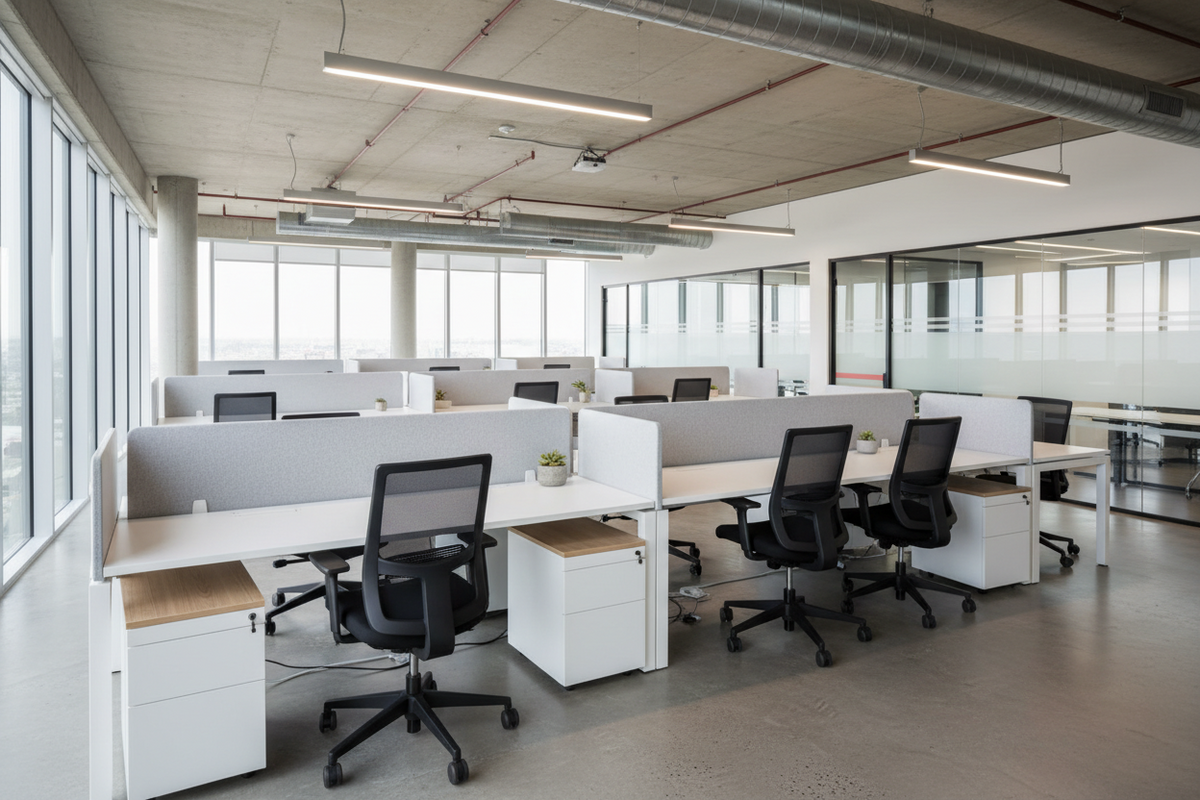
When an Ontario business sets out to furnish a floor of workstations, Haworth and Teknion are two names that surface quickly, and for good reason: both are serious systems-furniture makers with decades of contract projects behind them. The question worth slowing down on is not which brand is "better" in the abstract, because that depends entirely on what you are building. It is whether an American systems import or a Canadian-made systems line fits your floor plan, your budget, your timeline, and the way your organization buys and supports its furniture over the next ten years. This is a fair, fit-based comparison written for a buyer planning real workstations, not a takedown of either company.
Brant Business Interiors, a family-owned division of Office Central Inc. that has furnished Ontario workplaces since 1964, supplies Canadian-made systems furniture and does not sell Haworth, so our perspective is honest about that from the start. We are not going to tell you Haworth makes poor systems, because it does not. We will instead lay out where an imported systems platform and a Canadian-supported one each make the most sense, so the decision fits your project rather than the brand you happened to hear first. If you want the broader Canadian-versus-Canadian view, our companion comparison of Global and Teknion office furniture covers that ground, and the closely related look at Steelcase and Teknion in Ontario takes the same systems question from a different angle.
Haworth, fairly described
Let us give Haworth its due in plain terms. It is a long-established, privately held, family-owned manufacturer headquartered in Holland, Michigan, founded in 1948. Haworth helped define the modern office-systems category, and today it designs and builds seating, tables, movable walls, raised-access floors, panel systems, storage, and wood casegoods. The engineering is genuinely good, the design language is well regarded, and for organizations standardizing globally on one platform across many offices, that consistency carries real value.
The trade-offs are the predictable ones for an imported systems platform serving a single Ontario project. The supply chain, parts, and many of the specialized components route through an American manufacturer and its dealer network, which can lengthen lead times and complicate parts support years later when you need to add or reconfigure stations. Pricing on a premium import, multiplied across a forty-station floor, adds up. None of this makes Haworth a weak choice; these are simply the characteristics of buying an import for a local project, and they are exactly the points where a Canadian-made line can fit a regional buyer better.
Teknion, fairly described
Teknion is a Canadian contract-furniture manufacturer headquartered in Toronto, Ontario, and it is one of the strongest systems names in the country. It builds workstations, benching, panel systems, walls, and seating for large commercial and institutional projects, and its design and engineering sit comfortably alongside the global majors. For an Ontario buyer, the obvious draw is that this is a home-grown company whose systems are designed and largely produced in Canada, with a supply chain that does not cross a border to reach a Toronto, Ottawa, or Hamilton job site.
We supply Teknion as one of the contract lines we carry, so our interest here is in fit rather than in talking you out of it. What we will not do is attach specific warranty terms, dimensions, or a product-level country-of-origin claim to an individual Teknion item in this article, because those belong on a verified specification sheet, not in a comparison post. At the company level the picture is clear enough: Teknion is a major Canadian systems manufacturer, and for a buyer who values a domestic supply chain, that is a meaningful point in its favour.
Choosing by what you are building, not by the badge
Because both are capable systems makers, the right answer depends on your project. Rather than crown a winner, here is how the two tend to line up across the factors that actually decide a workstation rollout. Read it as a fit guide, not a scoreboard.
| Factor | Haworth (imported systems platform) | Teknion (Canadian systems manufacturer) |
|---|---|---|
| Origin and supply chain | Designed and built in the United States; components ship across a border to an Ontario site | Canadian company; a domestic supply chain reaching Ontario sites without an import leg |
| Global standardization | Strong fit if you are rolling out one platform across many international offices | Strong fit for Canadian and North American projects rather than a single global SKU list |
| Lead time and reconfiguration | Capable, but adds and changes can route back through an import channel | Parts and additions generally sourced and supported closer to home |
| Cost across a floor | Premium import pricing multiplied across every station | Competitive domestic pricing on comparable contract-grade systems |
| Local planning and install | Delivered through its dealer network | Specified, delivered, and installed by a local Ontario dealer |
| Public-sector purchasing | A standard commercial procurement path | Available through a Canadian dealer with provincial purchasing agreements |
Where a Canadian-supported system usually fits an Ontario floor better
A supply chain that does not cross a border
For a single Ontario project, where the furniture is made and stocked is not a small detail. A Canadian-made systems line means the panels, work surfaces, and storage that build your floor are sourced and supported without an import leg, which tends to mean tighter lead times and easier parts support when you add a pod of stations in year three. That matters most precisely when a project is on a deadline or a growing team needs to expand a floor that is already installed.
One accountable local partner for the whole floor
A systems project is not a box of chairs; it is a planned floor with power and data, privacy, storage, and circulation that all has to work together. Buying through a local dealer means one team plans the layout, delivers and installs it, and stays reachable for the life of the furniture, the same accountable contact when you reconfigure two years later. That is harder to replicate when the platform is specified globally and shipped in from another country.
A purchasing path an import cannot match
For public-sector and institutional buyers this is often decisive. Brant Business Interiors is registered under our parent legal entity, Brant Basics, as an authorized OECM Supplier Partner, so eligible Ontario broader-public-sector organizations such as school boards, hospitals, municipalities, and colleges can buy contract systems furniture through an established provincial agreement, in many cases without issuing a separate public tender. A premium import sold through a standard commercial channel does not offer that route, which on its own often settles the question for an institution equipping a floor.
A concrete Canadian systems example
To make this tangible rather than abstract, consider a workstation system we carry from the Canadian manufacturer Global Furniture Group. The Global Zira executive workstation is a complete ten-foot by ten-foot private-office configuration built from the Zira desking platform, pairing a P-top island desk and connecting return with integrated filing, storage, and an overhead hutch, all in thermally fused laminate and tested to exceed ANSI/BIFMA standards under a Limited Lifetime Warranty. We point to it not because it is the only answer but because it shows what a Canadian-made system delivers a business: a planned, reconfigurable workstation built and warranted as contract-grade, supplied and serviced close to home, and scalable across a floor as a team grows. The same logic runs through panel-based workstation systems for open-plan teams and a wider range of office desks and workstations, all of which we can plan around your floor plate. Our Global and Teknion brand overview gathers the Canadian contract lines we recommend most often.
How to judge any office-systems vendor, whichever brand
Because the real decision is fit and not badge, it helps to know what separates a system that ages well from one that frustrates a facilities team. Run any shortlist, import or domestic, through these checks before you commit a floor to it:
- Reconfigurability. Confirm how easily stations are added, shrunk, or relocated, and whether the parts to do that will still be available and supported in a few years.
- Power and data integration. A workstation system lives or dies on how cleanly it routes power and cabling. Ask to see the actual power components, not a rendering.
- Privacy and acoustics. Panel heights, screens, and materials should match how the team actually works, from heads-down focus rows to collaborative pods.
- Lead time and install. Get a real delivery-and-installation window for your quantity, and confirm who plans the layout and who installs it.
- Warranty and duty rating. The system should be built and warranted as contract-grade for all-day, multi-year commercial use, with the terms on a verified specification, not implied.
Walk a shortlist through those five points and the choice usually clarifies itself. A capable import and a strong Canadian line will both pass; the difference then comes down to supply chain, local planning and support, cost across the floor, and how your organization buys, which is exactly where this comparison lands.
When Haworth is the right choice
We said this would be fair, so here is the other side plainly. There are good reasons an organization lands on Haworth, and we would not argue against them:
- You are standardizing globally. If your business is rolling out one furniture platform across offices in several countries, a global manufacturer with that reach is a logical anchor.
- A specific Haworth product is already specified. If a designer or corporate standard has named a particular Haworth system, matching it across sites has real value.
- Brand consistency is a stated requirement. For some corporate environments the platform itself is part of the standard, and that is a legitimate reason to choose it.
The point of this comparison is not to move you off a capable system. It is to make sure the brand you reach for first is genuinely the best fit for an Ontario floor, your budget, and the way you will support that furniture for the next decade, rather than the option you knew by name.
Frequently Asked Questions
Is Haworth better than Teknion for office workstations?
Neither is simply better; they fit different projects. Haworth is a strong choice for organizations standardizing one platform across many international offices, while Teknion, as a Canadian systems manufacturer, tends to fit a single Ontario or North American project better on supply chain, local support, and cost across a floor. For most regional buyers the more useful question is which one fits your floor plan, timeline, and budget, not which brand wins in the abstract.
Is Teknion a Canadian company?
Yes. Teknion is a contract-furniture manufacturer headquartered in Toronto, Ontario, and it is one of Canada's major systems-furniture makers, building workstations, benching, panel systems, and seating for large commercial and institutional projects. For an Ontario buyer who values a domestic supply chain, that home-grown manufacturing base is a genuine point in its favour.
Does Brant Business Interiors sell Haworth furniture?
No. We supply Canadian-made and Canadian-supported contract systems, including lines from Global Furniture Group and Teknion, and we do not sell Haworth. We reference Haworth here only to give an honest, fit-based comparison for buyers weighing an imported systems platform against a Canadian-supported one, never to imply we carry it.
Are office-systems furniture and panel workstations worth it over standalone desks?
For a team of any size, usually yes. A planned system integrates power, data, privacy, and storage across a floor, scales cleanly as you add people, and is built and warranted for years of multi-user use, which standalone desks bought piecemeal rarely match. The value shows up most in reconfiguration: a good system lets you move and grow without starting over.
How do Haworth and Teknion compare on price in Ontario?
As a general pattern, a premium American import like Haworth carries import pricing that is multiplied across every station on a floor, while a Canadian-made contract line supplied locally tends to land more competitively on comparable systems. Exact pricing depends on configuration, quantity, and finishes, so the fair comparison is a quote built around your actual floor plan rather than a list price.
Can an Ontario institution buy a workstation system without a tender?
Often, yes. Brant Business Interiors is registered under our parent legal entity, Brant Basics, as an authorized OECM Supplier Partner, so eligible Ontario broader-public-sector organizations such as school boards, hospitals, and municipalities can purchase contract systems furniture through that provincial agreement, which in many cases removes the need for a separate public tender. An imported platform sold through a standard commercial channel does not provide that path.
The bottom line
Haworth makes capable office systems, and for an organization standardizing globally or matching a named corporate standard, it is a defensible choice. For an Ontario business furnishing a floor of workstations, a Canadian-made systems line supplied and supported locally often fits better on the things that decide a project: a supply chain that does not cross a border, one accountable partner to plan and install and reconfigure, competitive cost across every station, and an OECM purchasing path for institutions. Both are real options; the question is which one fits the floor you are building. Tell us about your project and request a quote, or call 1-800-835-9565, and we will help you weigh it honestly. We are at 296 George St N, Peterborough ON K9J 3H2, family-owned since 1964.
This article is provided for general informational purposes only and does not constitute legal, financial, procurement, or other professional advice. Pricing and specifications reflect publicly available manufacturer information and Canadian market data and are subject to change without notice. Brant Business Interiors makes no representations or warranties, express or implied, as to the accuracy, completeness, or currency of this content. For details specific to your project, please contact us for a quote or consultation.Published June 29, 2026.