

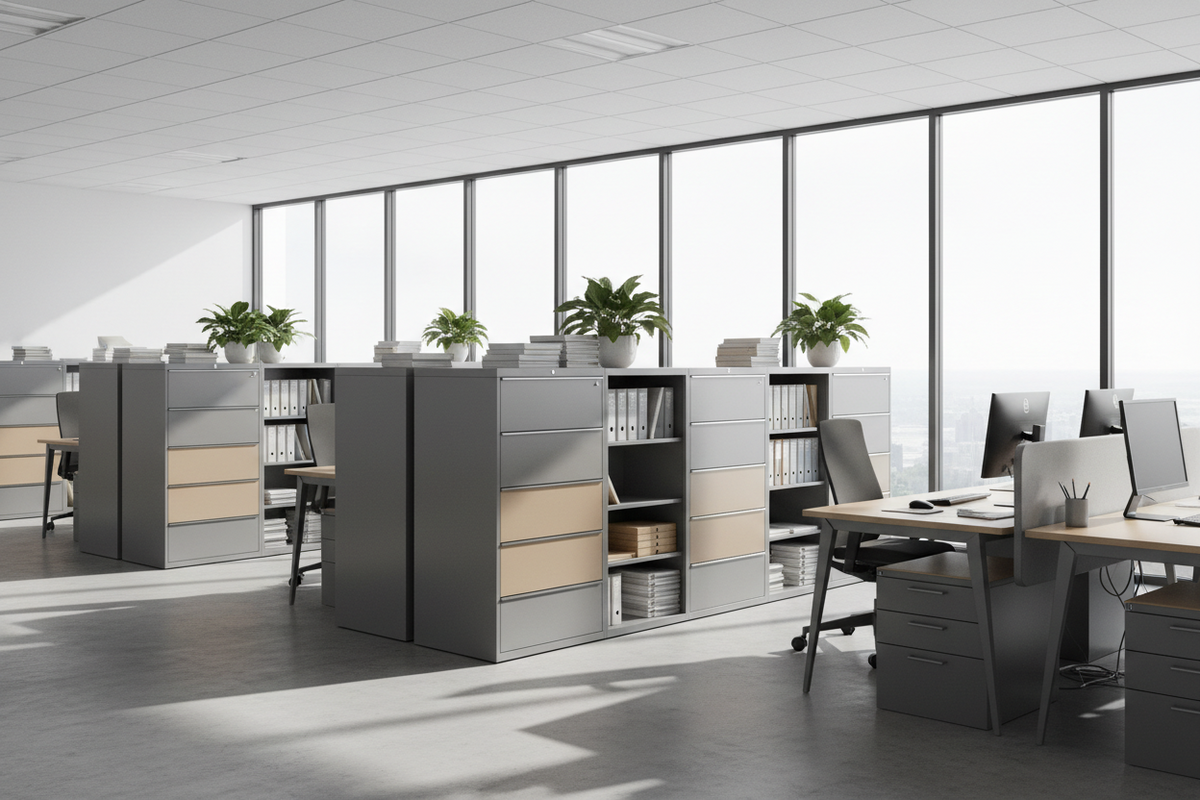
Office storage is not one decision but three: filing cabinets for documents, open shelving for reference and display, and pedestals for personal under-desk storage. Most offices need some of each, and the trick is matching the type to what is being stored, how often it is reached for, and how secure it has to be. This is the 2026 guide to commercial office storage, with a ranked set of real picks we carry, the vertical-versus-lateral filing question settled, and where to buy it in Ontario. It is about specifying the right mix, not buying a wall of filing cabinets no one opens.
Brant Business Interiors, a family-owned division of Office Central Inc., in business since 1964, supplies the full range of commercial storage across Ontario. Below we rank picks from the Canadian manufacturer we carry most for storage, Global Furniture Group, on verified specs rather than marketing.
The main commercial storage types, compared
Each type earns its place on footprint, capacity, access, and security. Match the type to the job and you stop paying for storage that sits unused.
| Storage type | Footprint | Access & capacity | Best for |
|---|---|---|---|
| Vertical file | Deep and narrow; pulls front-to-back | High density in a small width; drawers extend far | Corners and narrow spaces, high-volume archiving |
| Lateral file | Wide and shallow; pulls side-to-side | Easy file viewing; doubles as a credenza surface | Active files in shared areas, along a wall |
| Open shelving / bookcase | Vertical, open front | Fast grab-and-go; no locking | Reference binders, supplies, display |
| Pedestal | Small, fits under a desk | Personal box and file drawers, lockable | Per-person storage at each workstation |
| Storage / secure cabinet | Tall, enclosed | Mixed shelf and file, lockable, fire-rated options | Supplies, confidential records, legal originals |
Vertical vs lateral filing: the question everyone asks
The most common storage decision is vertical versus lateral, and it comes down to space and access. Vertical cabinets are deep and narrow and pull out front-to-back, so they pack a lot of files into a small width and suit corners or tight rooms, at the cost of drawers that extend well into the walkway and files you read end-on. Lateral cabinets are wide and shallow and pull out side-to-side, so files are easy to see and the top doubles as a surface or credenza, at the cost of more wall length. As a rule: choose vertical to maximise capacity in a small footprint, and lateral for active files in a shared space where people pull folders all day.
Our top picks by storage type (commercial-grade, Ontario-stocked)
These are real units we carry, built to last in daily commercial use. The dividing line from a home-grade cabinet is welded steel and a tested suspension, not a label.
- Our #1 pick, lateral filing: the Premium Series lateral file. A Global lateral cabinet built with fully welded, reinforced steel and integrated full pulls, available in two to six drawer heights for letter, legal, or A4, with cam locks standard and individual locking optional. The workhorse of commercial filing and our default for active records along a wall.
- Best vertical filing: the 2600-series vertical file. A welded-steel cabinet with full-extension ball-bearing suspension and a removable-core lock, about 128 lb for a four-drawer legal unit, meeting or exceeding ANSI/BIFMA at BIFMA LEVEL 2 and GREENGUARD emissions compliant. Maximum capacity in a narrow footprint.
- Best pedestal: the Newland mobile pedestal. A compact 16-inch-wide box-and-file mobile pedestal that fits under a desk, with both drawers front-locking, a counterweight to prevent tipping, and BIFMA LEVEL plus GREENGUARD Gold certification. Per-person storage at every workstation.
- Best open shelving: the bookcase range. A laminate bookcase offered in roughly 15 sizes from one to four shelves, with adjustable shelves and GREENGUARD certification on the contract laminate. Grab-and-go storage for binders, supplies, and display.
Secure, lockable, and fire-rated storage
Some records cannot just sit on a shelf. Canadian businesses keep many documents for years, the CRA generally requires business records to be retained for six years, and Ontario organisations handling personal or health information have their own safeguarding duties under privacy law. That is where lockable and fire-rated storage earns its place. Most commercial filing comes with cam locks as standard, and for confidential or irreplaceable records you can step up to a fire-rated cabinet such as a FireKing fire-rated cabinet, which carries a UL Class 350 one-hour fire rating, holds its interior below 350°F while the exterior exceeds 1,700°F, and is built from cold-rolled steel over a gypsum-and-steel-lattice core. For a mix of shelving and locked filing in one tall footprint, a multi-storage cabinet combines both, with locks keyed alike and a BIFMA and GREENGUARD-rated steel build. Match the security level to what you are storing: cam-locked filing for everyday confidentiality, fire-rated for legal originals and records you cannot replace.
Do you still need filing if you are paperless?
Mostly less, not none. Even a largely digital office keeps signed contracts, legal originals, HR files, and records it is legally required to retain, and those need secure, often lockable storage. The 2026 shift is one of balance: many Ontario offices are moving floor space away from rows of filing toward a smaller core of secure filing plus more open shelving and per-desk pedestals. The decision is no longer how many filing cabinets, but the right mix of filing, shelving, and pedestals for how your team actually works.
Where to buy office storage in Ontario
You will find filing cabinets and bookcases at Staples, Costco, and Amazon, often lighter-gauge consumer units fine for a home office or light use. For commercial filing that survives daily use, holds its locks, and matches across reorders, the steel-built contract range from a Canadian manufacturer like Global is the better buy, and it is sold through a dealer who can plan the storage into your layout and service it later. Fire-rated and high-security storage comes from specialists such as FireKing and Sentry. Brant Business Interiors carries the commercial filing, shelving, pedestals, and secure cabinets, plans the mix, and delivers and installs across Ontario, alongside other dealers in the province.
Frequently Asked Questions
What is the difference between filing cabinets and shelving?
Filing cabinets store documents in drawers, usually lockable, and suit records you need to keep secure and organised. Open shelving and bookcases store binders, reference material, and supplies for fast grab-and-go access, with no locking. Most offices use both: filing for confidential and archived documents, shelving for everyday reference and display.
Should I choose a vertical or lateral filing cabinet?
Choose a vertical file to pack the most documents into the smallest width, which suits corners and narrow rooms, accepting that drawers pull far into the walkway. Choose a lateral file when files are pulled often and easy viewing matters, since the wide, shallow drawers make folders simple to see and the top doubles as a surface. Vertical wins on density; lateral wins on access.
What is an office pedestal?
A pedestal is a small storage unit, usually with a mix of box and file drawers, that fits under or beside a desk for one person's everyday storage. Mobile pedestals roll out on casters and lock, so each workstation has its own secure storage without a separate cabinet. They are the standard per-desk storage in a commercial office.
What storage do I need for confidential or legal records?
Use lockable storage for everyday confidential files, which most commercial filing provides with cam locks as standard, and step up to a fire-rated cabinet for legal originals and records you cannot replace. Fire-rated units carry a UL fire rating that keeps the interior cool enough to protect paper in a fire. Match the security to the sensitivity and to any retention rules you are subject to.
Do you still need filing cabinets if your office is digital?
Usually yes, just fewer. Signed contracts, legal originals, HR records, and documents you are legally required to retain still need secure, often lockable storage, even in a paperless office. The trend is toward a smaller core of secure filing alongside more open shelving and per-desk pedestals, rather than rows of cabinets.
The bottom line
Office storage is a mix, not a single buy: filing for documents, shelving for reference, pedestals for personal storage, and secure or fire-rated cabinets for records that have to be protected. Our top pick for active filing is the steel Premium Series lateral file, with vertical files, pedestals, bookcases, and fire-rated cabinets to round out the mix. Tell us what you are storing and we will plan the storage into your layout, supply it across Ontario, and install it. Request a Quote or call 1-800-835-9565 to start with a free design layout.
This article is provided for general informational purposes only and does not constitute legal, financial, procurement, or other professional advice. Pricing and specifications reflect publicly available manufacturer information and Canadian market data and are subject to change without notice. Brant Business Interiors makes no representations or warranties, express or implied, as to the accuracy, completeness, or currency of this content. For details specific to your project, please contact us for a quote or consultation.Published June 4, 2026.