

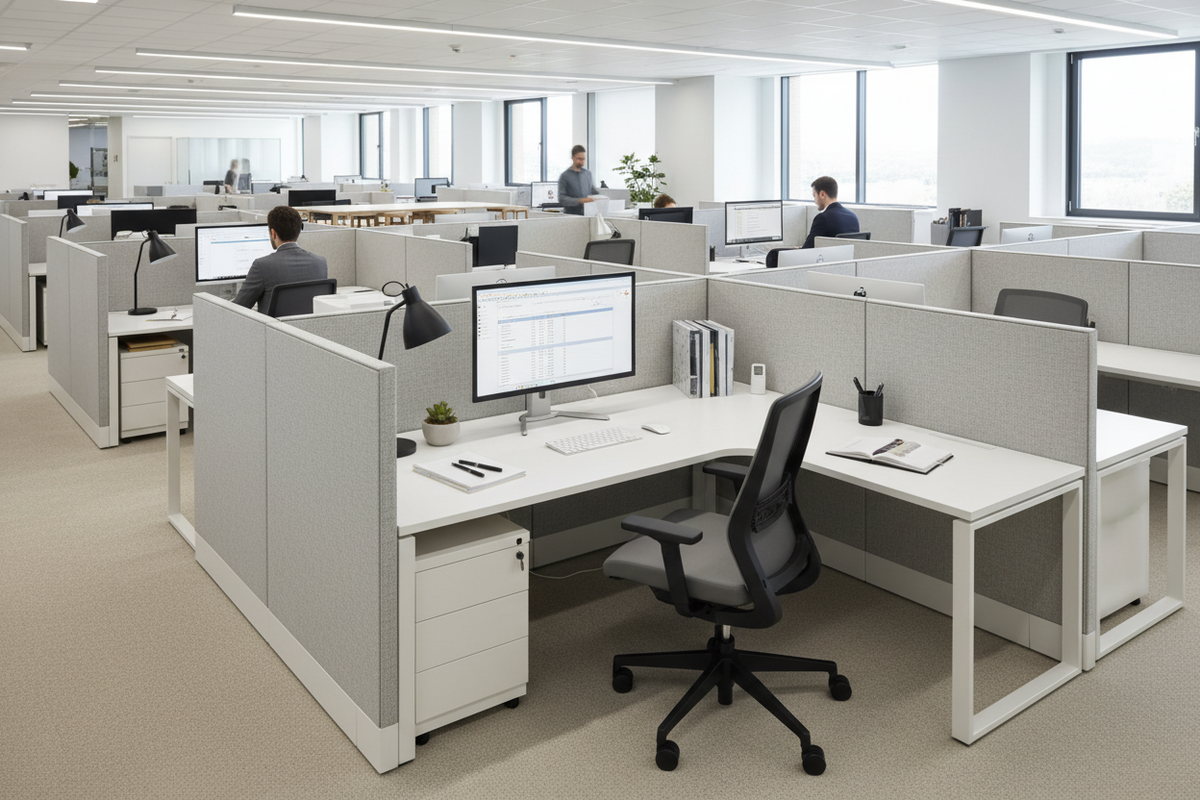
Cubicles and open benching are two ways to build the same thing: the workstations on an open floor. Cubicles wrap each desk in panels for privacy; benching lines desks up on shared runs for collaboration and density. The right one depends on the work, and the modern answer is often somewhere in between. This is the 2026 workstation-level decision for an Ontario office, the desks themselves, with a top commercial pick we carry and where to buy it.
Brant Business Interiors, a family-owned division of Office Central Inc., in business since 1964, builds both across Ontario. This guide matches the workstation to the work, with our top pick from the Canadian manufacturer we carry most for workstations, Global Furniture Group. If your question is open floor versus private offices rather than the desks themselves, that is a different decision we cover separately.
Cubicles vs benching, side by side
They solve opposite problems. Cubicles buy privacy at the cost of space and openness; benching buys collaboration and density at the cost of privacy.
| Factor | Cubicles (panelled) | Open benching |
|---|---|---|
| Privacy | High; panels block sightlines and some sound | Low by default; add screens for some separation |
| Collaboration | Lower; panels are barriers | Higher; people share a run and talk easily |
| Density and space | Uses more floor per person | Fits more people in the same area |
| Cost | Higher; panels, frames, and more parts per station | Lower; shared structure and fewer components |
| Flexibility | Reconfigurable but heavier to move | Easy to add seats and reconfigure |
| Best for | Focus-heavy or confidential roles; call-heavy work | Collaborative teams; growing or changing teams |
Why cubicles fell out of favour, and why they are not dead
Benching took over because open, collaborative layouts became the default and full-height cubicles came to feel closed-in and dated. Gensler's U.S. Workplace Survey found that most office workers prefer a mix, open collaborative areas paired with private space for focused work, rather than a one-size-fits-all open or cubicle floor. But the pendulum did not swing all the way: fully open benching with no separation runs into the same noise-and-focus problems that push people back toward some enclosure. Cubicles are not dead; they evolved. Today's versions use lower panels, glass tops, and integrated storage, keeping a measure of privacy without the cubicle-farm feel.
The modern middle ground
Most offices no longer choose strictly one or the other. The common, sensible build is benching with the right amount of screening: shared desk runs for collaboration and density, with low or mid-height privacy screens, and a few higher-panel workstations where focus or confidentiality demands it. That gives you benching's cost and flexibility plus enough separation to keep people productive. Where someone needs real quiet or call privacy, an acoustic pod or quiet room does the job better than tall panels and keeps the floor flexible.
Our top pick (commercial-grade, Ontario-stocked)
For the benching base most Ontario offices should start from, the pick is a shared run that takes screening and power cleanly and is built to commercial standards.
- Our #1 pick: our 96-by-50 benching run. A four-person Ionic benching station from Global on a steel H-leg frame with a 1-inch thermally fused laminate top, an optional PET-felt divider, and GREENGUARD certification, tested to ANSI/BIFMA. It seats four in a compact, collaborative footprint and accepts screens and power as you need them, the efficient core of an open floor.
- For the privacy stations: step up to a panelled workstation such as a Zira executive workstation where a role needs more enclosure, and add an acoustic pod for the few people who need real quiet, rather than panelling the whole floor.
Where to buy office workstations in Ontario, and what it costs
Benching generally costs less per workstation than a panelled cubicle, because it shares structure across a run and uses fewer components per seat, which is one reason it has become the default. As a rough guide, a commercial benching seat often lands well below a fully panelled cubicle of similar quality, and the gap narrows the more privacy screening you add. You can buy workstations from big-box and online channels, but a floor of desks needs planning and installation, not just shipping. Canadian dealers, including Brant Business Interiors alongside Source Office Furniture, POI, and atWork, and Canadian-content sources like fluidconcepts, plan the layout and install it, using lines from manufacturers such as Global, Teknion, and Groupe Lacasse. Brant Business Interiors specs the right balance of benching and panels for your floor and installs it across Ontario.
Frequently Asked Questions
What is the difference between cubicles and benching?
Cubicles are individual desks enclosed by panels for privacy; benching systems are shared desk runs, arranged in rows, with minimal or optional barriers for collaboration and density. Cubicles favour focus and confidentiality; benching favours teamwork, flexibility, and fitting more people in the same space. Many offices now use benching with added privacy screens to get some of both.
Are cubicles outdated?
Full-height cubicle farms have fallen out of favour, and surveys show few workers prefer them, but cubicles have evolved rather than disappeared. Modern versions use lower panels, glass, and integrated storage to keep privacy without feeling closed-in. For focus-heavy or confidential roles, a contemporary panelled workstation is still a sound choice.
Are cubicles or open benching better for an office?
Neither is universally better. Cubicles suit focus-heavy, confidential, and call-heavy work; benching suits collaborative, growing, and changing teams and uses space more efficiently. The strongest setups often combine them: a benching base with privacy screens, plus a few higher-panel stations and an acoustic pod or two for the work that needs quiet.
What are the disadvantages of cubicles?
Cubicles use more floor space per person, cost more because of the panels and parts per station, can feel isolating or dated in full-height form, and make spontaneous collaboration harder. Lower-panel modern designs reduce the isolation, but cubicles still trade openness and density for privacy.
Is benching cheaper than cubicles?
Generally yes. Benching shares structure across a run and uses fewer components per seat, so it usually costs less per workstation than a panelled cubicle and fits more people in the same area. The savings shrink if you add a lot of privacy screening, which is one reason a planned mix often beats an all-or-nothing choice.
The bottom line
Cubicles versus benching is a workstation decision, and most offices are best served by a mix: a benching base for collaboration and density, privacy screens and a few panelled stations where focus matters, and a quiet space for the rest. Our top pick to anchor that base is our 96-by-50 benching base, with panelled stations and a pod where the work needs them. Brant Business Interiors builds the whole mix and installs it across Ontario. Tell us how your team works and request a free design layout. Request a Quote or call 1-800-835-9565.
This article is provided for general informational purposes only and does not constitute legal, financial, procurement, or other professional advice. Pricing and specifications reflect publicly available manufacturer information and Canadian market data and are subject to change without notice. Brant Business Interiors makes no representations or warranties, express or implied, as to the accuracy, completeness, or currency of this content. For details specific to your project, please contact us for a quote or consultation.Published June 4, 2026.