

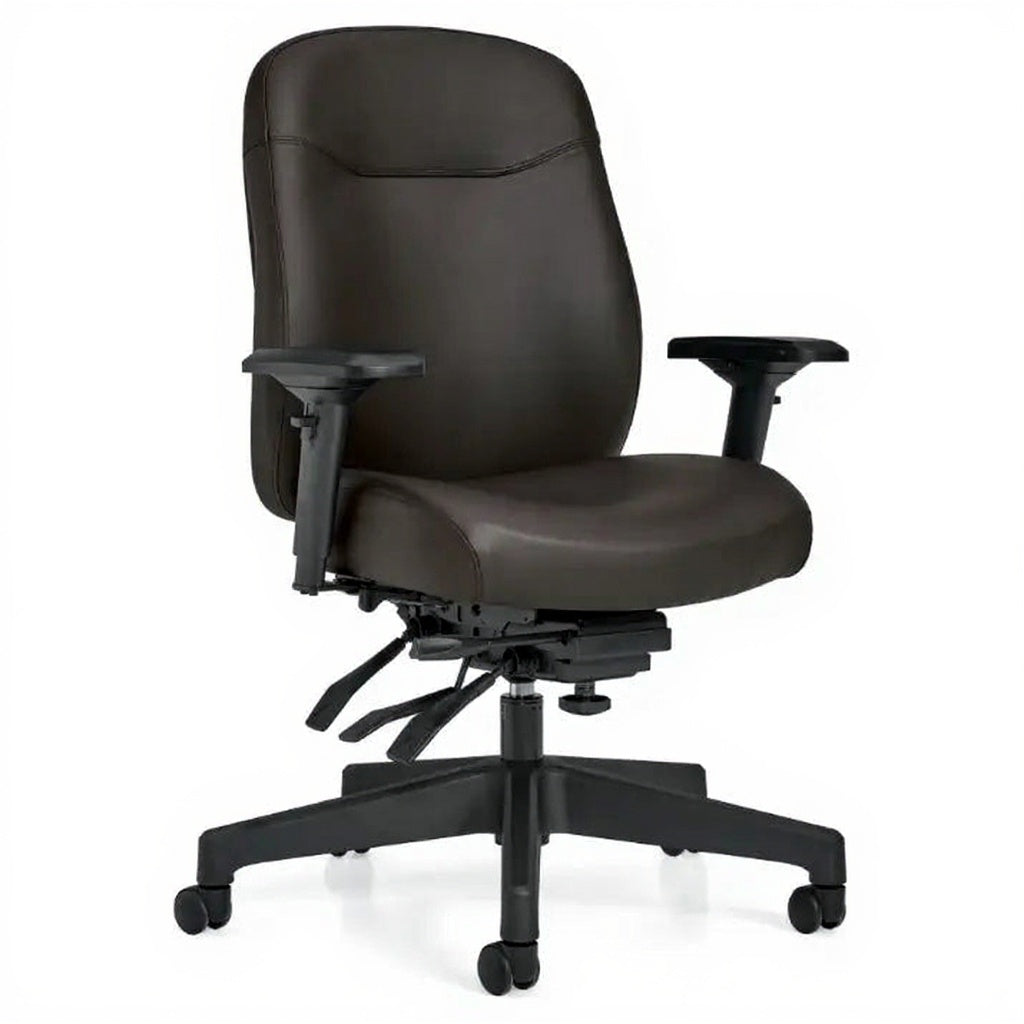
The single most expensive mistake in furnishing an office is buying consumer-grade furniture for a commercial space. It looks identical in a photo and costs less at checkout, then fails years sooner under daily use, so you pay for it twice. This is the plain-language guide to what makes office furniture commercial-grade, how to tell it from the consumer-grade pieces sold beside it, and why the difference decides your real cost over the life of the furniture.
Brant Business Interiors, a family-owned division of Office Central Inc., in business since 1964, sells commercial-grade office furniture, so we will say plainly: for one person at home a few hours a day, consumer-grade is fine. For a business, it usually is not, and here is exactly why, with real products and the standards behind them.
What commercial-grade actually means
Commercial-grade, also called contract-grade, means furniture engineered and tested for frequent use by many different people, day in and day out, rather than light use by one person. It is not a marketing word; it is backed by third-party testing standards. In office furniture the marks that matter are:
- ANSI/BIFMA, the furniture industry's durability and safety standards. X5.1 is the general test method for office seating, a battery of separate strength, stability, and durability tests, each with its own pass level; X5.11 is the separate standard for large-occupant, heavy-duty seating.
- CSA or UL for electrical and structural safety. CSA is the Canadian Standards Association, the mark Canadian buyers know best.
- GREENGUARD and GREENGUARD Gold for low chemical emissions, which Ontario institutions, schools, and healthcare sites often require for indoor air quality.
- BIFMA LEVEL, a sustainability certification (levels 1 to 3), and CAL 117, a flammability standard, both common on contract seating.
A chair tested to ANSI/BIFMA X5.1 has passed that full battery of tests; a consumer chair carries no such proof. The certification is the dividing line, and it is the thing the cheaper lookalike is missing.
The "commercial-grade" label is not regulated
Here is the catch that trips up Canadian buyers in 2026. Unlike "Made in Canada," the phrase "commercial-grade" is not policed by anyone. Run a live search for "commercial-grade office furniture" in Canada and the results are full of sub-$250 flat-pack desks, around $170 on the big marketplaces, wearing the words "commercial grade" in the product title with no standard named anywhere on the page. The word is free; the testing is not. That is why the rest of this guide is about what to verify, not what the label says. If a product calls itself commercial-grade, the only question that matters is which standard it is tested to.
Commercial-grade vs consumer-grade, side by side
The two can look the same on a screen. They diverge on the things you cannot see in a photo.
| Attribute | Consumer / residential grade | Commercial / contract grade |
|---|---|---|
| Built for | One person, light daily use | Many users, all-day, multi-year use |
| Third-party rating | Usually none | ANSI/BIFMA, CSA/UL, often GREENGUARD |
| Frame and materials | Lighter-gauge steel, particleboard, lighter mechanisms | Heavier-gauge welded steel, denser cores, rated mechanisms |
| Weight capacity | Often unrated, or a low stated limit | Rated to ANSI/BIFMA X5.1 for general use (occupants to ~115 kg / 253 lb); heavy-duty models rated to the separate ANSI/BIFMA X5.11 (to ~180 kg / 400 lb and beyond) |
| Warranty | Months to a year or two | Multiple years, longer on some components |
| Service life | A few years before replacement | Seven to ten years or more, with parts and reorders available |
| Total cost of ownership | Lower sticker, higher over time | Higher sticker, lower over time |
What contract-grade looks like on real products
The standards are abstract until you see them on a spec sheet. Here are three commercial pieces we carry, from the Canadian manufacturer Global Furniture Group, where the difference from a consumer lookalike is written into the numbers.
| Product | Durability specs that prove the grade |
|---|---|
| Accord high-back chair | 300 lb active weight capacity per seat with a 1,000 lb static load rating; GREENGUARD Gold and BIFMA LEVEL 3 certified; CAL 117 flammability rated; engineered for single-shift commercial use |
| The Robust heavy-duty chair | Active weight capacity up to 500 lb on a 32-inch six-prong steel base, with casters each rated to 225 lb; built as heavy-duty, multi-shift seating |
| 2600-series steel vertical file | Welded steel cabinet with full-extension ball-bearing suspension and a removable-core lock; about 128 lb for a four-drawer legal unit; meets or exceeds ANSI/BIFMA, BIFMA LEVEL 2 and GREENGUARD emissions compliant |
None of those numbers, a 1,000 lb static rating, a 500 lb occupant capacity, a welded-steel file body, appears on a $170 flat-pack equivalent, because that product was never tested to produce them. A consumer chair beside The Accord high-back chair looks similar in a photo and behaves nothing like it after a year of shared, all-day use. Step up to a heavy-duty model like the Global Robust chair and the gap is even starker. The same logic carries into storage: a steel 2600-series vertical file is a different object from a particleboard cabinet that sags once it is full of legal folders.
How to tell if office furniture is commercial-grade
You do not need to be an expert. A few checks separate the real thing from a consumer product with a business photo:
- Look for the rating. ANSI/BIFMA, CSA or UL, and GREENGUARD should be stated, not implied. "Commercial-grade" with no standard behind it is just a word.
- Read the warranty. A multi-year warranty signals the maker expects the piece to last; a ninety-day warranty tells you the opposite.
- Check the weight capacity. A stated, generous capacity points to a tested frame; silence usually means a light one.
- Ask how it is sold. Contract-grade furniture is typically bought through a dealer who can supply specs, parts, and service, not just ship a box.
- Weigh it, literally. Heavier-gauge welded steel and denser cores make commercial pieces noticeably more solid than their consumer lookalikes.
Why it is worth it for a business: the total-cost math
Commercial-grade furniture costs more up front and less over its life, and the gap widens the more you buy. Take a single seat in an Ontario office. A $200 consumer chair replaced every two to three years runs to roughly $600 to $800 over a decade, before the disruption of repeated reordering and the lost warranty coverage. A commercial task chair bought once at $600, rated and serviceable, often outlasts the decade on the first purchase. Multiply that across twenty seats and the home-grade route quietly becomes the expensive one, and that is before Ontario's 13 percent HST applies to every replacement you did not need to make. The same lifecycle logic applies to desks, tables, and storage: the cost over the life of the piece, not the sticker, is the number that matters for a business. This is why a higher-quality, third-party-rated piece is usually the cheaper one to own, and why commercial buyers think in years rather than at the register.
It applies across every category, not just one. Commercial-grade task chairs, office desks, and storage cabinets are all built and rated to a different standard than their consumer lookalikes, which is the through-line in every other buying decision an office makes.
When consumer-grade is fine
Commercial-grade is not always the answer. For a true home office used by one person, an occasional-use guest chair, or a short-term or disposable setup, consumer-grade can be the sensible, economical choice. The mistake is using home-grade furniture in a commercial setting, a busy reception area, a shared workstation, a staff room, and expecting it to last. Match the grade to the duty.
Frequently Asked Questions
What is commercial-grade office furniture?
Commercial-grade, also called contract-grade, is furniture engineered and third-party tested for frequent use by many people over years, rather than light use by one person. In offices the marks that prove it are ANSI/BIFMA for durability and safety, CSA or UL for electrical and structural safety, and often GREENGUARD for low emissions. The certification is what separates genuine commercial-grade from a consumer product labelled that way.
What is the difference between commercial and consumer-grade furniture?
Consumer or residential furniture is built for light, single-user use with lighter materials, little or no third-party rating, and a short warranty. Commercial furniture uses heavier-gauge welded frames and denser materials, carries ratings such as ANSI/BIFMA and CSA, holds more weight, and is warranted for years. They can look identical in a photo and behave very differently after a year of office use.
Is commercial-grade furniture worth the extra cost for a business?
For furniture used daily by a team, almost always. The higher sticker is offset by a much longer service life, a real warranty, and available parts, so the total cost of ownership over seven to ten years is usually lower than buying and replacing consumer-grade. The exception is genuinely light or temporary use, where consumer-grade can be the economical choice.
How can I tell if office furniture is commercial-grade?
Look for stated third-party ratings (ANSI/BIFMA, CSA or UL, GREENGUARD), read the warranty term, check for a stated weight capacity, and note whether it is sold through a dealer who can provide specs, parts, and service. Heavier, more solid construction is another sign. If "commercial-grade" appears with no standard behind it, treat it as a marketing claim.
What weight capacity should a commercial office chair have?
General-purpose commercial task chairs are tested to ANSI/BIFMA X5.1, which rates them for occupants up to about 115 kg (253 lb, the standard's 95th-percentile figure). Heavy-duty and big-and-tall models are tested to the separate ANSI/BIFMA X5.11 standard, which covers roughly 253 to 400 lb, and some contract chairs go further. The two numbers come from two different standards, so check which one a chair is rated to rather than assuming.
What certifications should I look for in Canada?
Start with ANSI/BIFMA for durability and safety, and CSA, the Canadian Standards Association mark, for structural and electrical safety. For indoor air quality, look for GREENGUARD or GREENGUARD Gold, which Ontario schools, healthcare sites, and offices often require. BIFMA LEVEL signals sustainability and CAL 117 covers flammability. A reputable supplier can tell you which marks each line carries.
The bottom line
Commercial-grade office furniture is not a luxury label; it is a tested standard that decides how long your furniture lasts and what it really costs you. For anything used by a team, day after day, buy to the rating and the warranty, not to the sticker or the word in the title. Brant Business Interiors supplies commercial-grade office furniture and can confirm which third-party ratings each line carries before you commit. Tell us what you are furnishing and request a free design layout. Request a Quote or call 1-800-835-9565.
This article is provided for general informational purposes only and does not constitute legal, financial, procurement, or other professional advice. Pricing and specifications reflect publicly available manufacturer information and Canadian market data and are subject to change without notice. Brant Business Interiors makes no representations or warranties, express or implied, as to the accuracy, completeness, or currency of this content. For details specific to your project, please contact us for a quote or consultation.Published June 4, 2026.